















 Workout

 Meditation







When people talk about improving mobility, they often immediately think about stretching.
I used to think the same way.
If a joint felt stiff, my first reaction was usually to stretch the surrounding muscles and hold the position for several seconds. While stretching can certainly have a place in a balanced fitness routine, I eventually discovered another approach that changed how I thought about mobility: Controlled Articulated Rotations, commonly known as CARs.
CARs are slow, deliberate movements performed through a joint’s available range of motion. Instead of simply moving back and forth, the goal is to actively explore and control as much of the joint’s comfortable range as possible.
Related Stories
 To Do a Pull-up, Start With the Negative Ones: Five Keys to Doing Them Correctly
 How Did Joining Gym Bring A Change In Your Behavior?
What I particularly like about this approach is its simplicity. You don’t necessarily need weights, machines, or a large workout space. You need attention, control, and enough time to move deliberately.
In this guide, I’ll explain what Controlled Articulated Rotations are, how they differ from ordinary stretching, the major joints you can train, potential benefits, common mistakes, and how beginners can incorporate CARs into a mobility routine.
What Are Controlled Articulated Rotations?
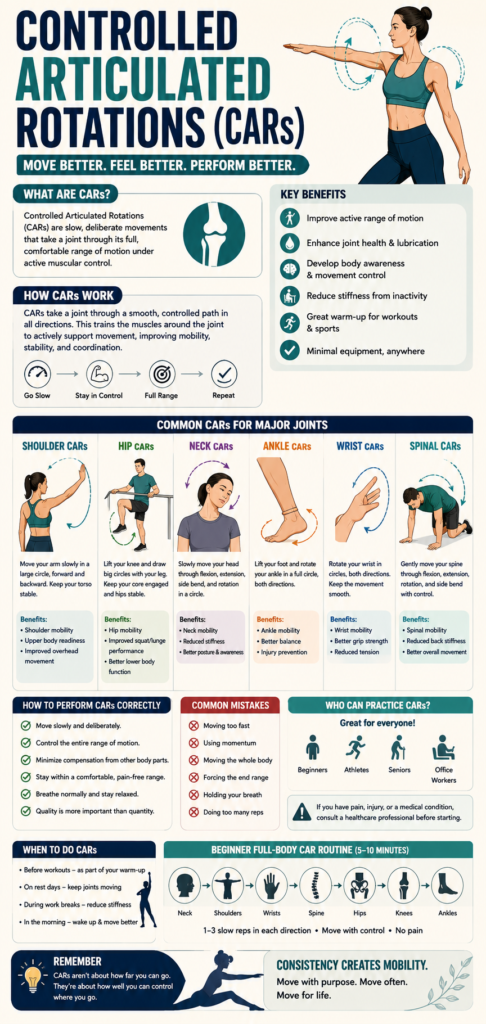
Controlled Articulated Rotations (CARs) are slow, active joint-mobility movements designed to take a joint through its available range of motion under muscular control.
The word “controlled” is important.

CARs aren’t supposed to be fast circles performed casually.
Instead, you intentionally control the movement from beginning to end.
For example, during a shoulder CAR, you might slowly raise your arm, rotate it through a large arc, and return it to the starting position while attempting to keep the rest of your body relatively still.
The same general concept can be applied to:
- Shoulders
- Hips
- Neck
- Wrists
- Ankles
- Spine
CARs are commonly used in mobility training, strength and conditioning, rehabilitation settings, and movement preparation.
What Does CARs Stand For?
CARs stands for Controlled Articular Rotations.
You may also see the phrase written as Controlled Articulated Rotations in fitness content.
The fundamental idea is the same: actively and deliberately move a joint through its available range rather than relying solely on passive stretching.
How Controlled Articulated Rotations Work?
A CAR typically involves moving a joint slowly through a large, comfortable range while keeping the surrounding body relatively stable.
Imagine performing a hip CAR.
Instead of simply swinging your leg around, you actively control the leg as it moves through different positions.
This requires coordination between:
- Joint movement
- Muscular contraction
- Balance
- Proprioception
- Core stability
- Motor control
The exercise therefore isn’t just about how far you can move.
It’s also about how well you can control the movement.
Why I Find CARs Useful?
What makes CARs different from many conventional mobility exercises is the emphasis on active control.
If I simply pull my arm into a stretch with my other hand, I’m relying partly on an external force.
With a CAR, my muscles have to actively create and control the movement.
That distinction can make mobility practice feel more purposeful.
I also like that CARs encourage me to pay attention to asymmetries.
For example, one hip may feel smoother or more controlled than the other. That doesn’t automatically mean something is wrong, but noticing differences can help guide future training.
Mobility vs Flexibility.
These two terms are often used interchangeably, but they aren’t exactly the same.
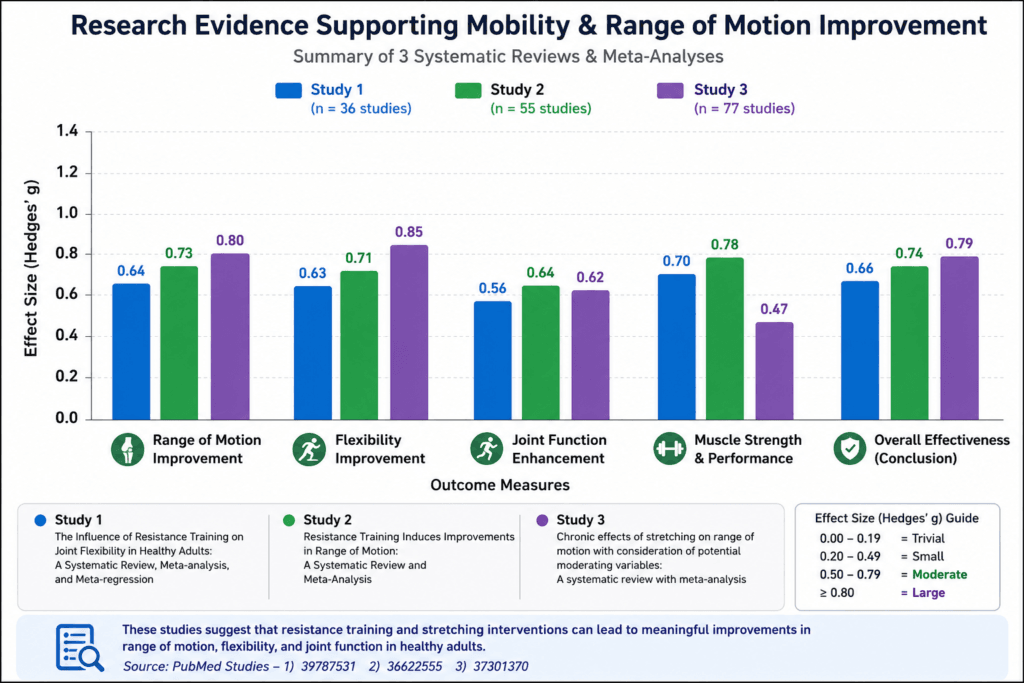
Flexibility generally refers to the ability of tissues to lengthen or a joint to move through a particular range.(1)
Mobility is broader and includes the ability to actively control movement through a range of motion.
For example, you might have enough passive flexibility to move your leg into a certain position, but struggle to actively place and control your leg there.
That’s one reason mobility training can complement traditional stretching.
Benefits of Controlled Articulated Rotations.
CARs aren’t a magical solution for every mobility problem, and research specifically examining CARs themselves is still more limited than research on broader mobility training.
However, the underlying principles of active range-of-motion exercise and regular movement practice are well established.
Potential benefits include the following.
1. Helps Maintain Joint Mobility.
Regularly moving joints through their available ranges can help maintain movement capacity.
This can be particularly useful for people who spend long periods sitting or performing repetitive activities.
For example, desk work often means spending hours with the hips and shoulders in relatively fixed positions.
A short mobility routine can provide a useful movement break.
2. Improves Active Range of Motion.
Because CARs require muscular control, they can help you become more comfortable controlling movement near the edges of your available range.(2),(3)
The goal isn’t to force a joint beyond its natural limits.
Instead, you’re practicing controlled movement within a safe and comfortable range.
3. Develops Body Awareness.
CARs require concentration.
You need to notice:
- Where the joint is moving
- Whether other body parts are compensating
- Where movement feels restricted
- Whether the movement remains smooth
This can improve proprioception and overall awareness of how your body moves.
4. Encourages Joint-Specific Movement.
A common problem during mobility exercises is allowing other parts of the body to compensate.
For example, when someone performs a shoulder movement, they may rotate their torso instead of actually moving the shoulder through its range.
CARs encourage you to minimize unnecessary compensation.
That makes the exercise more specific to the joint you’re trying to train.
5. Can Be Used as a Warm-Up.
CARs can be incorporated into a warm-up before strength training, sports, or other physical activities.
A few controlled repetitions can help you mentally and physically prepare for movement.
However, CARs should generally be gentle rather than exhausting.
6. Requires Minimal Equipment.
One of the biggest advantages is accessibility.
Most CAR exercises require nothing more than your own body.
That means you can practice them:
- At home
- At the gym
- At work
- While traveling
- Before a workout
7. May Help Reduce Stiffness From Inactivity.
Long periods of inactivity can leave joints feeling stiff.
Gentle active movement may help you feel less restricted after sitting for extended periods.
For someone working at a desk, a brief mobility break can be more practical than trying to fit in a full workout.
8. Supports Movement Quality.
Mobility isn’t just about achieving extreme ranges.
Good movement also requires control.
CARs encourage slow, deliberate movement, which can help you become more familiar with your available range.
Types of Controlled Articulated Rotations.
CARs can be performed for many joints.
Some of the most common include:
- Shoulder CARs
- Hip CARs
- Neck CARs
- Ankle CARs
- Wrist CARs
- Spinal CARs
Let’s look at each one.
Shoulder CARs.
Shoulder CARs are among the most popular variations.
They involve moving the arm slowly through a large circular pathway while attempting to keep the torso stable.
How to Perform a Shoulder CAR?
- Stand upright.
- Keep your core gently engaged.
- Start with one arm beside your body.
- Slowly raise the arm forward.
- Continue moving it overhead.
- Rotate the arm as it moves behind you.
- Bring it back toward the starting position.
- Reverse the movement.
Move slowly throughout.
Avoid forcing the shoulder into a painful position.
What Shoulder CARs Target?
They involve movement at the shoulder complex while also requiring stabilization from the:
- Core
- Upper back
- Shoulder muscles
Hip CARs.
Hip CARs are particularly useful for people who want to develop greater awareness and control of hip movement.
How to Perform a Hip CAR?
You can perform this standing while holding onto a stable surface.
- Stand tall.
- Shift your weight onto one leg.
- Lift the opposite knee.
- Slowly move the knee outward.
- Continue rotating the leg backward.
- Return it to the starting position.
- Reverse the movement.
Keep your torso as stable as possible.
Avoid turning the entire body to create additional movement.
Neck CARs.
Neck CARs involve gently moving the cervical spine through a controlled range.
Because the neck is sensitive, these should be performed particularly slowly.
You can gently move through:
- Flexion
- Extension
- Rotation
- Side bending
Never force the neck into a painful or extreme position.
Ankle CARs.
Ankle CARs are simple and can be performed seated or standing.
Lift one foot slightly from the floor and slowly rotate the ankle through its available range.
This can be useful as part of a warm-up before:
- Running
- Squatting
- Hiking
- Jumping activities
Wrist CARs.
Wrist CARs can be particularly useful for people whose activities involve repetitive hand movements.
Slowly rotate the wrist in one direction and then the other.
They can easily be incorporated into a warm-up before:
- Weightlifting
- Yoga
- Gymnastics
- Typing-intensive work
Spinal CARs.
Spinal mobility exercises are somewhat different from isolated joint rotations because the spine consists of multiple joints.
Controlled spinal movements can include carefully coordinated flexion, extension, rotation, and lateral movement.
These should be performed within a comfortable range rather than forcing the spine into extreme positions.
How to Perform CARs Correctly?
The quality of the movement matters more than the number of repetitions.
Here are the principles I focus on.
Move Slowly.
A CAR should often take several seconds rather than being performed rapidly.
Maintain Control.
Don’t allow momentum to carry the joint through the movement.
Minimize Compensation.
Try to keep other parts of your body relatively still.
Use a Comfortable Range.
Your available range may change from day to day.
Don’t force it.
Breathe Normally.
Avoid holding your breath unnecessarily.
Slow breathing can help you remain relaxed and focused.
How Many CARs Should You Do?
You generally don’t need dozens of repetitions.
For many beginners, 1–3 slow repetitions per joint in each direction can be enough to introduce the movement.
The goal is quality rather than fatigue.
As you become more experienced, you can adjust the duration, range, and number of repetitions according to your goals and training program.
Who Can Practice Controlled Articulated Rotations?
CARs can be useful for:
- Recreational exercisers.
- Athletes.
- Strength-training enthusiasts.
- Yoga practitioners.
- Desk workers.
- People interested in mobility training.
However, having a particular injury or medical condition can change which movements are appropriate.
If a joint is acutely painful, swollen, unstable, or recently injured, it’s better to seek individualized advice rather than attempting to mobilize it aggressively.
Beginner Controlled Articulated Rotations Routine.
If you’re completely new to CARs, you don’t need a complicated routine.
Try:
| Movement | Repetitions |
|---|---|
| Neck CARs | 1 each direction |
| Shoulder CARs | 2 each side |
| Wrist CARs | 2 each direction |
| Hip CARs | 2 each side |
| Ankle CARs | 2 each side |
| Gentle spinal mobility | 2–3 repetitions |
The entire sequence can take only a few minutes.
The important part is to remain deliberate and avoid turning the routine into a fast series of circles.
When Is the Best Time to Do Controlled Articulated Rotations?
There isn’t one universally correct time to perform CARs. The best timing depends on what you’re trying to accomplish.
Before a Workout.
CARs can work well as part of a general warm-up.
For example, before a lower-body workout, you might perform:
- Hip CARs
- Ankle CARs
- Gentle spinal mobility
Before an upper-body session, you could include:
- Shoulder CARs
- Wrist CARs
- Thoracic mobility movements
The objective isn’t to fatigue yourself. Keep the movements controlled and relatively low volume.
On Rest Days.
CARs can also be useful on days when you’re not performing a demanding workout.
A few minutes of gentle joint movement can provide an opportunity to stay active without creating substantial training fatigue.
During Work Breaks.
If you spend several hours sitting at a desk, short movement breaks can be valuable.
Rather than remaining in the same position for hours, you could stand up and perform a few gentle shoulder, hip, or ankle movements.
As Part of a Morning Routine.
Some people enjoy using CARs shortly after waking up.
The movements can help you become aware of areas that feel stiff after sleeping.
However, don’t force stiff joints immediately after waking. Start gently and allow your body to gradually loosen.
Controlled Articulated Rotations Before Strength Training.
One of the most practical uses of CARs is preparing for strength training.
Suppose you’re planning to squat.
You might use:
- Ankle CARs
- Hip CARs
- Gentle spinal mobility
If you’re training your upper body, you might use:
- Shoulder CARs
- Wrist CARs
- Thoracic mobility
After this general mobility work, perform your normal activity-specific warm-up sets.
For example, before heavy squats, don’t rely on CARs alone. Gradually increase the load through several warm-up sets.
CARs for Athletes.
Athletes often require a combination of:
- Strength
- Power
- Mobility
- Coordination
- Stability
CARs can be included as one component of a broader training program.
A runner might emphasize ankle and hip mobility.
A swimmer might spend more time on shoulder movement.
A weightlifter may focus on shoulders, hips, ankles, and the thoracic spine.
The goal should be to address the movement demands of the sport rather than performing every possible CAR simply for the sake of it.
Mobility vs Stretching: Which Is Better?
This is a common question.
The answer is that they serve different purposes.
Stretching generally emphasizes increasing or maintaining flexibility.
Mobility training focuses more broadly on the ability to move and control a joint through a range of motion.
For example, someone may have enough passive hamstring flexibility to reach their toes but still struggle to actively control certain hip movements.
That’s why I don’t view CARs and stretching as competing approaches.
They can complement one another.
A balanced routine might include:
- CARs for active mobility
- Dynamic movements before exercise
- Static stretching when appropriate
- Strength training through useful ranges of motion
Common Mistakes When Performing CARs.
CARs look simple, but the quality of execution matters.
1. Moving Too Quickly.
This is probably the most common mistake.
Fast circles create momentum, which can make the movement easier but reduces the amount of active control required.
Slow down.
2. Using Momentum.
If you’re swinging your arm or leg, you’re no longer performing the movement in the controlled manner intended.
Think about actively guiding every part of the rotation.
3. Moving the Whole Body.
For example, during a shoulder CAR, you may accidentally rotate your torso to create a larger apparent shoulder range.
Try to keep the torso stable.
4. Forcing the End Range.
More movement isn’t automatically better.
Trying to force a joint farther than it comfortably wants to go can cause pain or irritation.
Work within your current controllable range.
5. Holding Your Breath.
Some people unconsciously hold their breath when concentrating.
Try to maintain relaxed, steady breathing.
6. Doing Too Many Repetitions.
CARs aren’t designed to exhaust a muscle.
A few high-quality repetitions can be more useful than dozens of rushed ones.
Should CARs Hurt?
A properly performed mobility exercise shouldn’t be painful.
You may notice:
- Mild muscular effort
- A gentle stretch
- Stiffness
- A feeling of restriction
But sharp, intense, or worsening pain is a reason to stop.
Pain can have many causes, so don’t assume that pushing through it will improve mobility.
If you have persistent joint pain, swelling, instability, numbness, or a recent injury, seek advice from an appropriately qualified healthcare professional.
How to Progress Your CAR Practice?
Once the basic movement becomes comfortable, progression doesn’t necessarily mean doing more repetitions.
You can progress by improving:
Control.
Make the movement slower and more deliberate.
Range.
Gradually explore a slightly larger range if it remains comfortable and controlled.
Stability.
Reduce unnecessary movement elsewhere in the body.
Strength.
Some advanced mobility programs combine controlled joint movements with strengthening exercises.
Consistency.
Practicing a few minutes regularly can be more sustainable than occasional long sessions.
A 10-Minute CAR Routine.
Here’s a simple routine you can use at home.
| Movement | Time |
|---|---|
| Neck CARs | 1 minute |
| Shoulder CARs | 2 minutes |
| Wrist CARs | 1 minute |
| Spinal mobility | 1 minute |
| Hip CARs | 2 minutes |
| Knee mobility | 1 minute |
| Ankle CARs | 2 minutes |
Move slowly and perform each exercise on both sides when appropriate.
You can modify the routine according to your needs.
CARs for Desk Workers.
If you sit for several hours each day, your movement routine doesn’t need to be complicated.
Try taking a short break every so often to:
- Stand up
- Walk around
- Move your shoulders
- Rotate your wrists
- Perform gentle hip movements
- Move your ankles
CARs can be included as part of this movement break.
However, no single exercise can completely offset prolonged sitting. Regular walking and changing positions throughout the day are also valuable.
CARs for Runners.
Running involves repetitive movement, so runners may benefit from paying attention to mobility at the:
- Ankles
- Hips
- Thoracic spine
A runner might use gentle ankle and hip CARs before a training session, followed by a more conventional dynamic warm-up.
CARs shouldn’t replace running-specific preparation.
CARs for Strength Training.
Strength athletes often need sufficient mobility to perform exercises safely and effectively.
For example:
Squat Training.
Focus on:
- Ankles
- Hips
- Spine
Bench Press.
Focus on:
- Shoulders
- Wrists
- Upper back
Overhead Press.
Focus on:
- Shoulders
- Thoracic spine
- Wrists
Again, mobility is only one part of good technique. Appropriate load selection and progressive strength training remain essential.
How Often Should You Do CARs?
For general mobility, CARs can be practiced regularly because they usually require little equipment and relatively low fatigue.
A simple approach is:
Beginners: 3–4 days per week
Intermediate: 4–6 days per week
Experienced practitioners: Short daily sessions if comfortable
There is no requirement to perform every joint every day.
Choose movements based on your goals and how your body feels.
Can CARs Improve Flexibility?
CARs may help you become more comfortable using your available range of motion, but they shouldn’t be considered a replacement for every type of flexibility training.
If improving flexibility is your primary goal, you may combine CARs with appropriate stretching.
For example:
Before exercise:
- CARs
- Dynamic movements
After exercise or separate session:
- Static stretching
- Relaxed mobility work
Can CARs Help With Injury Prevention?
It’s tempting to say that mobility exercises prevent injuries, but the evidence doesn’t support making such a broad guarantee.
Injury risk depends on many factors, including:
- Training volume
- Training intensity
- Technique
- Previous injuries
- Recovery
- Sleep
- Nutrition
- Individual anatomy
CARs can be a useful component of a movement and conditioning program, but they shouldn’t be treated as an insurance policy against injury.
Who Should Be Careful With CARs?
CARs are generally low-equipment movements, but that doesn’t mean they’re appropriate for every situation.
Use additional caution if you have:
- Recent surgery
- Acute joint injury
- Significant joint instability
- Severe pain
- Unexplained swelling
- Neurological symptoms
A physical therapist or other qualified healthcare professional can help determine which movements are appropriate for your particular situation.
Frequently Asked Questions.
1. What are Controlled Articulated Rotations?
Controlled Articulated Rotations, commonly called CARs, are slow and deliberate movements that take a joint through its available range of motion under active muscular control.
2. What is the purpose of CARs?
The main purpose is to develop active joint mobility, movement control, and awareness of available range of motion.
3. Can beginners do CARs?
Yes. Beginners can start with simple, slow movements and a comfortable range of motion.
4. How many CARs should I do?
You generally don’t need many repetitions. One to three controlled repetitions per joint can be a reasonable starting point.
5. Can I do CARs every day?
Many people can perform gentle CARs frequently, but your routine should be adjusted according to your individual needs, training load, and joint health.
6. Are CARs the same as stretching?
No. Stretching generally emphasizes tissue length and flexibility, while CARs emphasize active movement and control through a joint’s range.
7. Can CARs replace a warm-up?
Not completely. CARs can be one component of a warm-up, but strenuous exercise should generally include activity-specific preparation and progressive warm-up sets.
8. Can CARs improve joint mobility?
They may help maintain or improve active movement capacity when practiced consistently, although individual results vary.
9. Are CARs good for athletes?
They can be useful as part of a broader mobility and movement-preparation program tailored to the athlete’s sport.
A Simple Weekly CAR Plan.
If you want a straightforward routine, you don’t need to make it complicated.
Monday.
Shoulder + hip + ankle CARs
Tuesday.
Neck + wrist + spinal mobility
Wednesday.
Full-body CAR routine
Thursday.
Rest or gentle movement
Friday.
Shoulder + hip + ankle CARs
Saturday.
Full-body mobility
Sunday.
Rest or gentle movement
Keep each session short and focus on quality.
Final Thoughts.
Controlled Articulated Rotations are a simple but thoughtful approach to mobility training. Rather than chasing extreme flexibility or performing fast joint circles, CARs encourage you to slow down, pay attention, and actively control your available range of motion.
That’s what makes them useful.
You can perform shoulder CARs before an upper-body workout, hip and ankle CARs before lower-body training, or a short full-body routine during a break from sitting. They require little or no equipment and can be adapted to different fitness levels.
However, I wouldn’t treat CARs as a miracle solution. They are one tool within a much bigger picture of physical health. Strength training, cardiovascular exercise, adequate recovery, good nutrition, regular movement, and appropriate medical care all remain important.
If you’re new to mobility work, start conservatively. Move slowly, avoid forcing your joints, and pay attention to how your body responds. With consistency, CARs can become a useful part of a well-rounded movement routine.
+3 Sources
Verywelfit has strict sourcing guidelines and relies on peer-reviewed studies, educational research institutes, and medical organizations. We avoid using tertiary references. You can learn more about how we ensure our content is accurate and up-to-date by reading our editorial policy.
- The Influence of Resistance Training on Joint Flexibility in Healthy Adults: A Systematic Review, Meta-analysis, and Meta-regression; https://pubmed.ncbi.nlm.nih.gov/39787531/
- Resistance Training Induces Improvements in Range of Motion: A Systematic Review and Meta-Analysis; https://pubmed.ncbi.nlm.nih.gov/36622555/
- Chronic effects of stretching on range of motion with consideration of potential moderating variables: A systematic review with meta-analysis; https://pubmed.ncbi.nlm.nih.gov/37301370/