
















 Workout

 Meditation






The Third Eye Chakra, traditionally known as Ajna Chakra, is one of the most widely discussed energy centers in yoga and spiritual traditions. It is commonly associated with intuition, inner awareness, perception, wisdom, concentration, and the ability to look beyond immediate distractions.
One simple way people incorporate this symbolism into their daily routine is through Third Eye Chakra affirmations.
Affirmations are short statements repeated intentionally to reinforce a particular thought, value, or perspective. They can be used during meditation, journaling, yoga, breathwork, or simply as a quiet morning ritual.
However, it is useful to distinguish spiritual tradition from scientific evidence. There is currently no scientific evidence demonstrating that repeating an affirmation literally “opens” or physically balances a chakra. The chakra system belongs to traditional philosophical and spiritual frameworks rather than modern anatomy.
Related Stories
 Shirshasana or Headstand : Benefits, How to Do and Side Effects
 How the Falling Star Yoga Pose Helped Me Find Balance and Strength: Benefits, Steps, and Precautions
That doesn’t mean affirmations have no value. Research into self-affirmation suggests that certain affirmation-based psychological techniques can produce small but measurable effects on outcomes such as self-perception, well-being, and health-related intentions. A 2025 meta-analysis of 67 articles found small positive effects of self-affirmation interventions on self-perception, general well-being, and social well-being.
So, a practical approach is to use Third Eye Chakra affirmations as reflective statements that encourage qualities such as clarity, self-awareness, patience, and mindful decision-making, rather than as a medical treatment.
What Is the Third Eye Chakra?
The Third Eye Chakra is traditionally called Ajna, a Sanskrit term commonly associated with concepts such as perception, command, or knowing.
In modern yoga and spiritual practices, it is generally described as being located around the area between the eyebrows.

The Third Eye Chakra is commonly symbolized by qualities such as:
- Intuition
- Inner wisdom
- Awareness
- Mental clarity
- Perception
- Concentration
- Insight
- Reflection
- Discernment
Different spiritual traditions may interpret Ajna differently, so there isn’t one scientifically established definition of the chakra.
For many practitioners, however, focusing on the Third Eye provides a symbolic way to cultivate attention and introspection.
What Are Third Eye Chakra Affirmations?
Third Eye Chakra affirmations are positive or reflective statements designed around themes traditionally associated with Ajna Chakra.
Examples include:
“I trust myself to make thoughtful decisions.”
or:
“I allow clarity to emerge naturally.”
The purpose isn’t necessarily to convince yourself that something unrealistic is already true.
Instead, a useful affirmation should encourage a mindset or behavior you want to practice.
For example, rather than saying:
“I know everything.”
a more grounded affirmation might be:
“I remain open to learning and seeing situations clearly.”
This distinction makes affirmations more practical.
Do Third Eye Chakra Affirmations Really Work?
This question deserves an evidence-based answer.
There is no good scientific evidence that affirmations specifically activate, unblock, or balance the Third Eye Chakra.
However, psychological research has examined self-affirmation techniques.
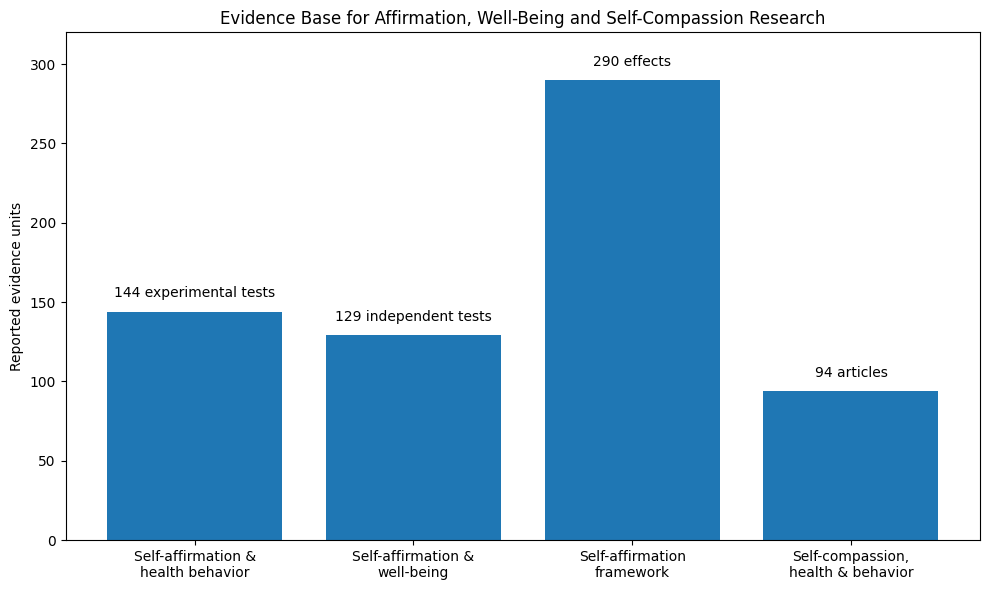
A meta-analysis involving 144 experimental tests found small but reliable positive effects of self-affirmation on health-message acceptance, intentions, and subsequent behavior.(1)
Another meta-analysis found small positive effects of self-affirmation interventions on self-perception, general well-being, and social well-being.(2)
These findings don’t prove that Third Eye Chakra affirmations have a special energetic effect.
Instead, they suggest that intentional reflection on personally meaningful values and beliefs can sometimes influence psychological outcomes.
That is the most scientifically responsible way to discuss affirmations.
100 Third Eye Chakra Affirmations.
Here are 100 affirmations centered around intuition, clarity, awareness, wisdom, focus, trust, and inner reflection.
Third Eye Chakra Affirmations for Intuition.
- I trust myself to listen to my inner wisdom.
- I am becoming more aware of my intuition.
- I allow myself to notice subtle insights.
- I trust myself to pause and reflect before deciding.
- My intuition deserves my attention.
- I listen carefully to my inner voice.
- I create space for insight to arise.
- I am open to seeing things from a new perspective.
- I trust myself to recognize what feels meaningful.
- I honor my inner knowing while remaining open-minded.
- I give myself permission to slow down and listen.
- I notice my instincts without allowing fear to control me.
- I can distinguish thoughtful intuition from impulsive reactions.
- I trust myself to gather information before making decisions.
- I am patient with my own understanding.
- I allow wisdom to develop with experience.
- I pay attention to what my mind and body are communicating.
- I respect my ability to perceive and learn.
- I remain curious about what I don’t yet understand.
- I trust myself to recognize when I need more information.
Third Eye Chakra Affirmations for Clarity.
- My mind can become calm and clear.
- I allow confusion to settle before making decisions.
- I focus on what is within my control.
- I see situations with greater perspective.
- I give myself time to think clearly.
- I release unnecessary mental clutter.
- I choose clarity over confusion.
- I can examine my thoughts without being controlled by them.
- I approach difficult situations with patience.
- I allow understanding to develop gradually.
- I can look at challenges from different perspectives.
- I remain present with what is happening now.
- I focus my attention on what matters most.
- I give myself permission to reconsider my assumptions.
- I am capable of thoughtful decision-making.
- I welcome moments of mental stillness.
- I don’t need to have every answer immediately.
- I can find clarity one step at a time.
- I choose thoughtful reflection over automatic reactions.
- I trust the process of learning and understanding.
Third Eye Chakra Affirmations for Inner Wisdom.
- Every experience can teach me something valuable.
- I learn from both success and difficulty.
- I allow experience to deepen my understanding.
- I respect the wisdom I have gained through life.
- I remain humble enough to keep learning.
- I can acknowledge what I know and what I don’t know.
- I make space for thoughtful reflection.
- I trust myself to grow through experience.
- I am willing to learn from different perspectives.
- I allow wisdom to guide my choices.
- I listen before I react.
- I value understanding over being right.
- I recognize that growth takes time.
- I can change my perspective when new information appears.
- I use my experiences to make wiser choices.
- I am learning to understand myself more deeply.
- I honor my personal growth.
- I allow patience to strengthen my judgment.
- I can learn from uncertainty.
- I approach life with curiosity and wisdom.
Third Eye Chakra Affirmations for Focus.
- I bring my attention back to the present moment.
- I can focus on one thing at a time.
- I give myself permission to disconnect from distractions.
- My attention is valuable.
- I choose where to direct my mental energy.
- I create moments of quiet in my day.
- I am becoming more comfortable with stillness.
- I focus on what deserves my attention.
- I allow myself to concentrate without rushing.
- I return gently to my chosen focus when my mind wanders.
Third Eye Chakra Affirmations for Self-Awareness.
- I observe my thoughts without judging myself.
- I am becoming more aware of my emotional patterns.
- I notice what influences my decisions.
- I give myself permission to understand my feelings.
- I can question thoughts that no longer serve me.
- I am honest with myself while remaining compassionate.
- I recognize the difference between fear and fact.
- I can step back and observe my reactions.
- I am learning more about who I am.
- I accept that self-awareness is an ongoing journey.
Third Eye Chakra Affirmations for Trust and Peace.
- I trust myself while remaining open to guidance.
- I don’t need to control every outcome.
- I can be comfortable with uncertainty.
- I choose patience when answers aren’t immediate.
- I allow myself to rest from constant thinking.
- I create peaceful moments for reflection.
- I release the need to know everything right now.
- I can respond thoughtfully instead of reacting automatically.
- I trust myself to handle challenges as they arise.
- I give myself permission to slow down.
Third Eye Chakra Affirmations for Spiritual Reflection.
- I am open to meaningful self-reflection.
- I make time to connect with myself.
- I approach my spiritual practice with curiosity.
- I honor the beliefs that bring meaning to my life.
- I remain open to learning from different traditions.
- I create space for silence and reflection.
- I allow myself to explore my inner world.
- I approach spiritual practices with awareness and balance.
- I trust my personal journey without comparing it to others.
- I am present, curious, aware, and open to growth.
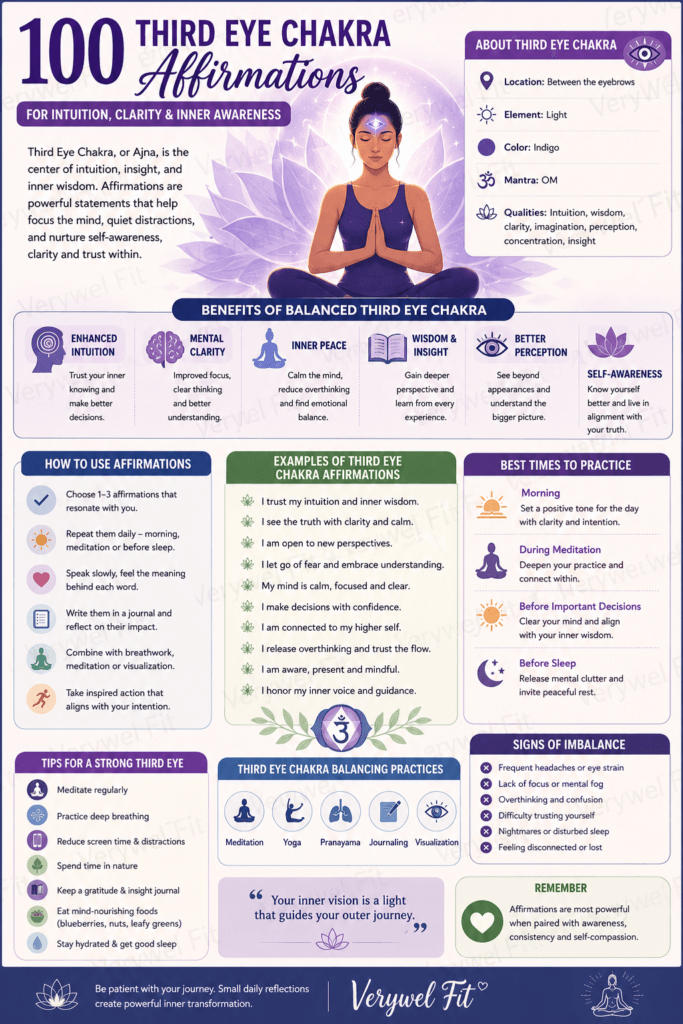
How to Use Third Eye Chakra Affirmations?
You don’t need a complicated ritual.
Choose one or two affirmations that genuinely resonate with you and repeat them slowly.
For example:
Morning:
“I choose clarity and thoughtful awareness today.”
During meditation:
“I observe my thoughts without judgment.”
Before making an important decision:
“I give myself time to understand before I decide.”
Before sleep:
“I release the need to solve everything tonight.”
The goal isn’t to repeat dozens of statements mechanically.
A single meaningful affirmation can be more useful than repeating 50 statements without paying attention to their meaning.
Third Eye Chakra Affirmations During Meditation.
Meditation can provide a natural setting for affirmations.
Try this simple five-minute practice:
Minute 1: Settle.
Sit comfortably and take several natural breaths.
Minute 2: Focus.
Bring your attention gently toward the area between your eyebrows if that feels comfortable.
You don’t need to strain your eyes or physically concentrate on that point.
Minute 3: Repeat.
Choose one affirmation.
For example:
“I welcome clarity and awareness.”
Repeat it slowly.
Minute 4: Observe.
Notice your thoughts without trying to force them away.
Minute 5: Finish.
Take a few comfortable breaths and return your attention to your surroundings.
This approach keeps the practice simple and grounded.
Third Eye Chakra Affirmations for Morning.
Morning affirmations can help establish an intentional mindset before the day becomes busy.
Try:
- “I begin today with clarity.”
- “I will listen before I react.”
- “I trust myself to make thoughtful decisions.”
- “I am open to learning today.”
- “I choose awareness over distraction.”
- “I approach challenges with patience.”
- “I allow myself to focus on what matters.”
- “I welcome new perspectives.”
- “I trust myself to handle today’s decisions.”
- “I move through today with curiosity.”
Third Eye Chakra Affirmations Before Sleep.
Evening affirmations can be used as a reflective practice.
Try:
- “I release today’s mental clutter.”
- “I allow my mind to rest.”
- “I don’t need to solve everything tonight.”
- “I am grateful for what I learned today.”
- “I release thoughts that no longer need my attention.”
- “I give myself permission to rest.”
- “Tomorrow can bring new perspective.”
- “I accept what I cannot change tonight.”
- “My mind deserves moments of quiet.”
- “I end today with patience and self-compassion.”
How to Make Affirmations More Effective?
Simply repeating positive words isn’t guaranteed to change your thoughts or behavior.
A more useful approach is to connect an affirmation with something meaningful and realistic.
For example:
Instead of:
“I will never feel confused.”
try:
“When I feel confused, I can pause and gather more information.”
The second statement acknowledges that confusion is normal while giving you a practical response.
Research suggests that self-affirmation effects can vary depending on the situation, the type of affirmation, and the psychological context.(3)
Make Them Personal.
Choose language that sounds natural to you.
If an affirmation feels completely unbelievable, modify it.
Instead of:
“I am perfectly confident in every decision.”
try:
“I am learning to trust my decision-making process.”
Connect Words With Action
An affirmation works best as part of a behavior rather than as a replacement for one.
For example:
Affirmation:
“I choose clarity.”
Action:
“I will spend five minutes writing down the facts before making an important decision.”
This turns a general statement into a practical habit.
Third Eye Chakra Affirmations and Self-Compassion
Not every affirmation needs to focus on confidence or achievement.
Self-compassion can also be incorporated into reflective practices.
Research involving large pooled samples has found associations between self-compassion and physical health and health-promoting behavior, although this evidence doesn’t specifically concern Third Eye Chakra practices.(4)
Consider statements such as:
- “I can learn without criticizing myself.”
- “I am allowed to make mistakes.”
- “I can be honest with myself and still be kind.”
- “I don’t need to know everything.”
- “I can grow at my own pace.”
These may be more psychologically realistic than constantly demanding positivity.
What Third Eye Chakra Affirmations Cannot Do?
It’s important not to make unsupported health claims.
Third Eye Chakra affirmations should not be presented as a cure for:
- Anxiety disorders
- Depression
- Migraines
- Vision problems
- Hormonal disorders
- Thyroid conditions
- Neurological disorders
- Insomnia
- Chronic pain
Nor should affirmations replace prescribed medication, psychotherapy, medical evaluation, or other appropriate treatment.
If you’re experiencing persistent physical or psychological symptoms, seek professional care.
Can Affirmations “Open” the Third Eye?
In spiritual traditions, practitioners may use phrases such as “opening the Third Eye” to describe increased awareness, intuition, insight, or spiritual perception.
This is a spiritual interpretation, not a scientifically established physiological process.
There is no anatomical structure called the Third Eye Chakra that can be medically opened or closed.
For a health and wellness article, it is more accurate to describe “opening the Third Eye” as a traditional or symbolic concept rather than a proven biological event.
How Often Should You Practice?
There is no scientifically established frequency specifically for Third Eye Chakra affirmations.
You could try:
5 minutes each morning, or
5 minutes in the evening, or
one affirmation throughout the day.
Consistency is more important than duration.
You can also change your affirmation depending on what you’re currently working on.
For example:
Monday: Clarity
Tuesday: Focus
Wednesday: Self-awareness
Thursday: Patience
Friday: Intuition
Weekend: Reflection
Journaling With Third Eye Chakra Affirmations.
Combining affirmations with journaling can make the practice more reflective.
Choose one statement and write:
Affirmation:
“I trust myself to make thoughtful decisions.”
Then ask:
- What decision am I currently struggling with?
- What facts do I already know?
- What am I assuming?
- What am I afraid might happen?
- What additional information do I need?
- What choice aligns with my values?
This approach moves the practice beyond simply repeating words.
Frequently Asked Questions.
1. What are Third Eye Chakra affirmations?
They are short statements inspired by qualities traditionally associated with Ajna Chakra, including intuition, awareness, clarity, focus, wisdom, and inner reflection.
2. What is the best Third Eye Chakra affirmation?
There isn’t one universally best affirmation. A useful option is: “I welcome clarity and trust myself to make thoughtful decisions.”
3. Can Third Eye Chakra affirmations increase intuition?
They may encourage you to pay more attention to your thoughts, feelings, and perceptions, but there is no scientific evidence that affirmations directly increase a supernatural or psychic ability called intuition.
4. How many times should I repeat an affirmation?
There is no scientifically established number. Repeating one meaningful statement for several minutes or using it periodically throughout the day can be a simple approach.
5. Can I use Third Eye Chakra affirmations before sleeping?
Yes. Calm statements focused on reflection, acceptance, and letting go can be incorporated into an evening routine.
6. Can affirmations cure anxiety?
No. Affirmations shouldn’t be presented as a treatment or cure for an anxiety disorder. They can be part of a broader wellness routine, but persistent anxiety may require professional support.
7. Can I use affirmations during meditation?
Yes. You can silently repeat an affirmation during meditation while maintaining relaxed, natural breathing.
8. What color is associated with the Third Eye Chakra?
Indigo or deep blue-purple is commonly associated with Ajna Chakra in modern chakra systems. Color associations are traditional and symbolic rather than scientifically established.
9. Where is the Third Eye Chakra believed to be located?
In traditional and modern yoga contexts, it is commonly described as being around the area between the eyebrows. This is a spiritual framework, not an anatomical structure.
10. Can I write my own Third Eye Chakra affirmations?
Absolutely. Personalized affirmations can be more meaningful. Focus on qualities such as awareness, clarity, patience, discernment, self-trust, and curiosity.
11. Do I need to believe in chakras to use affirmations?
No. You can use the statements simply as mindfulness or self-reflection prompts without adopting a particular spiritual belief system.
Bottom Line.
Third Eye Chakra affirmations can be a simple way to incorporate reflection, mindfulness, and intentional thinking into your daily routine.
Traditionally, Ajna Chakra is associated with intuition, insight, perception, and inner awareness. However, there is no scientific evidence that affirmations physically activate or balance a chakra.
The more evidence-based perspective is to view affirmations as reflective statements. Research on self-affirmation suggests that certain approaches can have small positive effects on self-perception, well-being, and health-related intentions, although results vary and affirmations aren’t a substitute for professional care.
The best affirmation is therefore not necessarily the most dramatic one. It is the one that feels meaningful, realistic, and connected to an action you can take.
You don’t need to repeat all 100.
Choose one affirmation that reflects what you genuinely want to cultivate, sit quietly with it for a few minutes, and then allow your actions to reinforce the intention.
+4 Sources
Verywelfit has strict sourcing guidelines and relies on peer-reviewed studies, educational research institutes, and medical organizations. We avoid using tertiary references. You can learn more about how we ensure our content is accurate and up-to-date by reading our editorial policy.
- The impact of self-affirmation on health-behavior change: a meta-analysis; https://pubmed.ncbi.nlm.nih.gov/25133846/
- The impact of self-affirmation interventions on well-being: A meta-analysis; https://pubmed.ncbi.nlm.nih.gov/41143765/
- Reconceptualizing Self-Affirmation With the Trigger and Channel Framework: Lessons From the Health Domain; https://pubmed.ncbi.nlm.nih.gov/30295141/
- Self-compassion, physical health, and health behaviour: a meta-analysis; https://pubmed.ncbi.nlm.nih.gov/31842689/