








 Workout

 Meditation






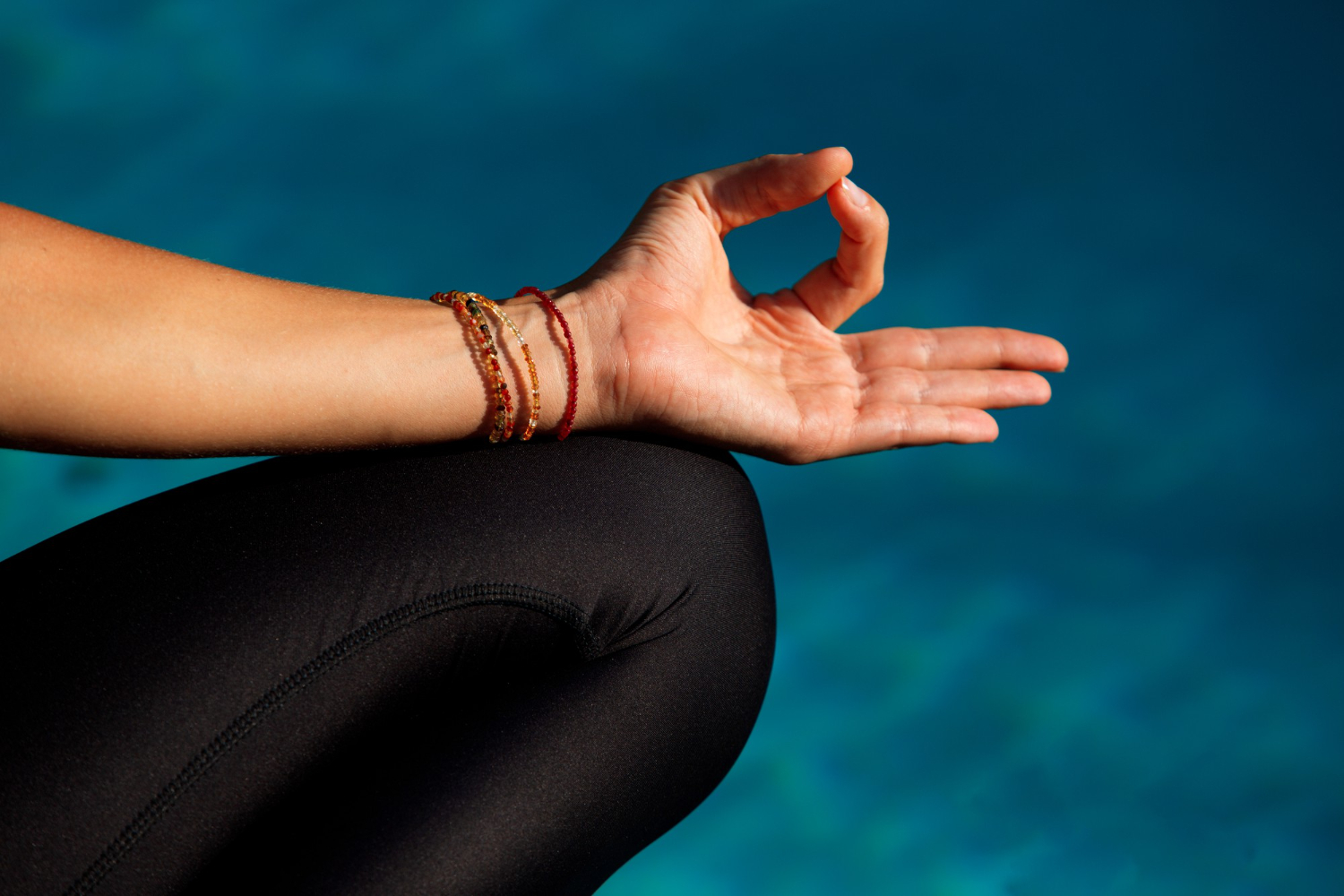
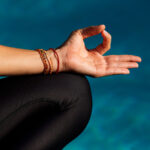
Tattva Mudra is a hand gesture used in traditional yoga and meditation practices. The Sanskrit word tattva is commonly translated as “principle,” “element,” or “fundamental reality,” while mudra refers to a symbolic hand gesture or seal.
When I first came across Tattva Mudra, what stood out to me was how simple the physical technique appeared. There is no complicated posture, equipment, or strenuous movement involved. The practice primarily involves positioning the fingers in a particular way while maintaining a comfortable posture and directing attention toward the breath or meditation.
Like many traditional mudras, Tattva Mudra is associated with philosophical concepts involving balance, awareness, and the relationship between the individual and the elements. However, it is important to distinguish traditional yogic interpretations from modern scientific claims.
There is limited high-quality clinical research specifically investigating Tattva Mudra. Therefore, claims that the gesture can cure disease, “detoxify” the body, balance specific organs, or produce guaranteed physiological changes should be treated cautiously.
Related Stories
 7 Simple Yoga Poses to Help You Lose Belly Fat After a C-Section
 100 Third Eye Chakra Affirmations for Intuition & Clarity
A more evidence-conscious way to approach Tattva Mudra is as a mindfulness or meditation practice that may complement an existing yoga routine.
The Meaning Behind Tattva Mudra.
The concept of tattva has a long history in Indian philosophical traditions.
In several yogic and philosophical systems, the physical world is discussed through the framework of fundamental elements or principles. These are often described as:
- Earth
- Water
- Fire
- Air
- Space
Different yoga traditions interpret mudras differently, and there isn’t one universally accepted explanation for every mudra.
Tattva Mudra is therefore best understood within the particular yoga tradition in which it is taught rather than assuming that every modern explanation represents an ancient universal rule.
The symbolic purpose is generally connected with awareness, balance, and contemplation.
Tattva Mudra vs Other Mudras.
One reason people become confused about Tattva Mudra is that numerous hand gestures have similar-looking names and finger positions.
Some commonly discussed mudras include:
- Gyan Mudra
- Chin Mudra
- Prana Mudra
- Apana Mudra
- Vayu Mudra
- Prithvi Mudra
- Surya Mudra
Each has its own traditional description.
Tattva Mudra may also be described differently depending on the lineage, teacher, or yoga school.
For this reason, if you’re learning it from a particular teacher, it’s worth following that teacher’s instructions rather than mixing several versions together.
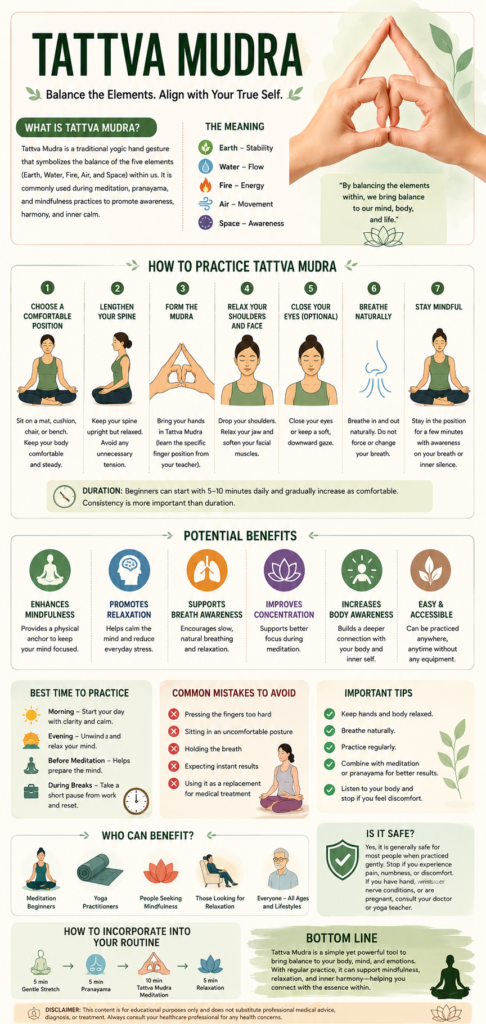
How to Perform Tattva Mudra?
Because variations exist, learn the specific finger arrangement from a qualified yoga teacher if your practice follows a particular lineage.
For a commonly taught version, begin by sitting comfortably and bringing the hands into the prescribed finger position while keeping the remaining fingers relaxed.
A basic practice can be approached as follows:
Step 1: Choose a Comfortable Position.
Sit on:
- A yoga mat
- A cushion
- A meditation bench
- A chair
You don’t need to sit cross-legged if that position is uncomfortable.
Step 2: Lengthen Your Spine.
Allow your spine to remain comfortably upright.
Avoid creating unnecessary tension by trying to sit rigidly.
Step 3: Position Your Hands.
Form the Tattva Mudra according to the version taught by your yoga instructor.
Keep the hands relaxed rather than pressing the fingers together forcefully.
Step 4: Relax the Shoulders.
Drop the shoulders away from the ears.
Relax the jaw and facial muscles.
Step 5: Close Your Eyes if Comfortable.
You can close your eyes or maintain a soft gaze.
Step 6: Breathe Naturally.
Don’t force your breathing.
Simply notice the rhythm of your inhalation and exhalation.
Step 7: Practice Mindfully.
Stay in the position for several minutes while maintaining attention on your breath or chosen meditation focus.
How Long Should You Practice Tattva Mudra?
There isn’t a scientifically established optimal duration specifically for Tattva Mudra.
If you’re new to the practice, 5–10 minutes is a reasonable starting point.
You can gradually increase the duration if it feels comfortable.
Some practitioners incorporate mudras into longer meditation sessions.
The important thing is consistency rather than forcing yourself to remain in the position for a very long period.
Potential Benefits of Tattva Mudra.
This is where it’s particularly important to separate traditional claims from scientific evidence.
There isn’t enough research to say that Tattva Mudra itself treats or prevents a specific disease.
However, incorporating a mudra into meditation may offer indirect benefits through the broader practice of relaxation and mindfulness.
1. Encourages Mindfulness.
Holding a specific hand position gives you a physical point of focus.(1)
Instead of allowing attention to wander continuously, you can notice:
- Your fingers
- Your breathing
- Your posture
- Your thoughts
- Your physical sensations
That can make meditation easier for some beginners.
2. Supports Relaxation.
A quiet meditation session may help create a sense of calm.
The potential relaxation benefit should be attributed to the overall practice rather than assuming that the hand gesture alone has a unique medical effect.
3. Promotes Body Awareness.
Mudras require you to pay attention to your hands and posture.
That awareness can become part of a broader mind-body practice.
4. Can Complement Yoga.
Tattva Mudra requires very little physical effort, making it easy to incorporate into:
- Meditation
- Pranayama
- Restorative yoga
- Gentle yoga
- Yoga nidra preparation
5. Requires No Equipment.
One thing I particularly appreciate about mudras is their practicality.
You can practice a hand gesture while sitting almost anywhere.
You don’t need:
- Weights
- Machines
- Special clothing
- A large room
Tattva Mudra and Meditation.
Meditation is probably one of the most natural settings for practicing Tattva Mudra.
Rather than treating the mudra as a standalone medical intervention, think of it as an anchor for attention.
For example:
- Sit comfortably.
- Place your hands in the mudra.
- Close your eyes.
- Take several natural breaths.
- Observe the sensation of breathing.
- When your mind wanders, gently return your attention to the breath and hands.
You don’t need to eliminate thoughts.
Meditation is generally about developing awareness rather than forcing the mind to become completely empty.
Tattva Mudra and Pranayama.
Some practitioners combine mudras with breathing exercises.
If you choose to do this, start with natural breathing rather than immediately attempting advanced pranayama.
A simple routine might include:
2 minutes: comfortable breathing
5 minutes: Tattva Mudra with breath awareness
2 minutes: quiet sitting
If you experience dizziness or discomfort during breathing exercises, stop and return to normal breathing.
When Is the Best Time to Practice?
There is no scientifically proven “best” time specifically for Tattva Mudra.
Choose a time when you can practice consistently.
Morning.
Morning practice can provide a quiet transition into the day.
Evening.
An evening session may fit naturally into a relaxation routine.
Before Meditation.
You can use Tattva Mudra as a physical cue that tells your mind it’s time to settle down.
During a Work Break.
If you spend long hours at a desk, a short meditation break can provide an opportunity to step away from work.
Remember that sitting continuously for long periods isn’t ideal simply because you’re practicing a mudra. Stand up and move regularly as well.
Tattva Mudra for Beginners.
If you’re completely new to mudras, don’t overcomplicate the practice.
Start with:
- A comfortable chair or cushion
- Relaxed shoulders
- Natural breathing
- A short practice duration
- Minimal distractions
Your first goal isn’t to achieve a particular mystical sensation.
Instead, focus on becoming familiar with the hand position and developing a consistent meditation habit.
Common Mistakes.
Mistake 1: Pressing the Fingers Too Hard.
A mudra doesn’t need to cause discomfort.
Keep the hands relaxed.
Mistake 2: Sitting Uncomfortably.
You don’t have to sit cross-legged.
A chair is perfectly acceptable if it allows you to maintain a comfortable posture.
Mistake 3: Holding Your Breath.
Unless you’re intentionally practicing a specific breathing technique under appropriate instruction, breathe naturally.
Mistake 4: Expecting Immediate Results.
Meditation and yoga practices aren’t necessarily about instant physical changes.
Give yourself time to develop consistency.
Mistake 5: Treating Traditional Claims as Medical Facts.
This is especially important.
Claims that Tattva Mudra can cure diabetes, hypertension, digestive disorders, thyroid disease, anxiety disorders, or other medical conditions aren’t supported by sufficient clinical evidence.
Use it as a complementary wellness practice—not as a replacement for medical care.
Is Tattva Mudra Safe?
For most healthy people, a gentle hand gesture practiced comfortably is unlikely to create significant physical stress.
However, some people may experience hand or wrist discomfort if they hold a position for too long.
Modify or stop if you experience:
- Pain
- Numbness
- Tingling
- Cramping
- Significant stiffness
People with hand, wrist, or nerve conditions may want individualized guidance from a healthcare professional or qualified yoga instructor.
Tattva Mudra During Pregnancy.
Pregnancy doesn’t automatically mean that all mudras are unsafe.
However, pregnancy is a time when yoga and breathing practices should be adapted to the individual’s stage of pregnancy and health.
If you’re pregnant, particularly if you have pregnancy complications, speak with your obstetric healthcare professional before beginning a new yoga or meditation program.
The hand gesture itself is generally less physically demanding than strenuous yoga poses, but the broader practice may still need modification.
Tattva Mudra and Mental Well-Being.
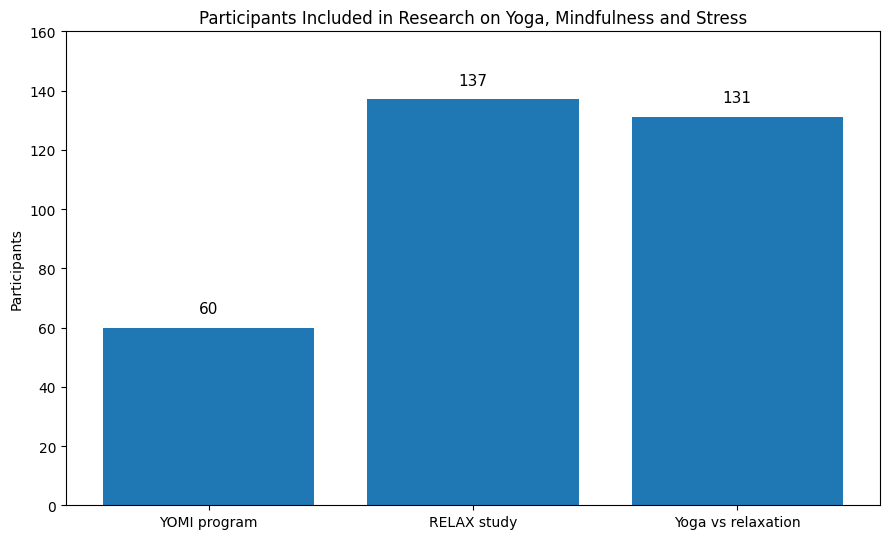
Meditation and yoga are increasingly studied for their potential effects on psychological well-being.(2)
However, we should avoid claiming that one particular mudra treats depression, anxiety, or another mental-health disorder.(3)
If you’re experiencing persistent anxiety, depression, panic attacks, or other mental-health symptoms, seek appropriate professional care.
Tattva Mudra can potentially be included as a relaxation or mindfulness practice alongside—not instead of—professional treatment.
A 10-Minute Tattva Mudra Practice.
Here’s a simple routine for beginners.
Minute 1–2: Settle.
Sit comfortably and allow your breathing to become natural.
Minute 3–4: Establish the Mudra.
Position your hands according to the version of Tattva Mudra you’re practicing.
Minute 5–8: Meditation.
Focus gently on your breathing.
When your attention wanders, return to your breath.
Minute 9–10: Finish.
Release the hand position.
Take a few comfortable breaths and slowly open your eyes.
There’s no need to rush immediately into another activity.
Can You Practice Tattva Mudra Every Day?
If the position is comfortable, daily practice can be a reasonable way to establish consistency.
You could begin with five minutes per day.
The key is not how many days you can force yourself to practice for a long time, but whether the practice fits naturally into your lifestyle.
For example:
Monday–Friday: 5–10 minutes
Weekend: Longer meditation if desired
There’s no requirement to practice for an hour.
Combining Tattva Mudra With Other Yoga Practices.
Tattva Mudra can be incorporated into a broader routine.
For example:
5 minutes: gentle mobility
5 minutes: pranayama
10 minutes: seated meditation with Tattva Mudra
5 minutes: relaxation
This gives you a short 25-minute mind-body practice without requiring an intense physical workout.
Who May Benefit From Practicing Tattva Mudra?
Because it is simple and requires little physical exertion, it may appeal to:
- Meditation beginners
- Yoga practitioners
- People interested in mindfulness
- Individuals looking for a quiet relaxation practice
- People who prefer low-impact wellness activities
But “may benefit” shouldn’t be confused with “medically treats.”
The strongest evidence is for broader practices such as mindfulness, meditation, and physical activity—not for Tattva Mudra specifically.
What Does Science Say About Mudras?
Mudras have a long traditional history, but modern scientific research specifically testing individual mudras remains limited.
Some studies investigate yoga, meditation, pranayama, or broader mind-body interventions. Those findings can provide useful context, but they shouldn’t automatically be attributed to Tattva Mudra.
For example, if a clinical trial finds that a structured yoga program improves a particular outcome, it doesn’t mean that one hand gesture from that program produced the result.
This distinction helps keep health content accurate.
Tattva Mudra vs Gyan Mudra.
Both are commonly used during meditation, but they shouldn’t be treated as interchangeable.
Gyan Mudra is traditionally associated with connecting the thumb and index finger.
Tattva Mudra can be taught using different finger configurations depending on the tradition.
If you’re unsure which version you’re learning, ask your instructor to demonstrate it.
Frequently Asked Questions.
1. What is Tattva Mudra?
Tattva Mudra is a traditional yogic hand gesture used in some yoga and meditation practices. The term is associated with concepts such as principles, elements, or fundamental reality.
2. What are the benefits of practicing Tattva mudra?
Potential benefits are best considered in the context of meditation and mindfulness. It may help provide a physical focus for attention and support a calming practice, but there is insufficient evidence to claim that Tattva Mudra itself treats specific medical conditions.
3. How long should I practice Tattva Mudra?
Beginners can start with approximately 5–10 minutes and gradually increase the duration if comfortable. There is no scientifically established ideal duration specifically for this mudra.
4. Can I practice Tattva Mudra every day?
Yes, if the hand position is comfortable. A short daily practice can be easier to maintain than occasional lengthy sessions.
5. Can Tattva Mudra cure diseases?
There is insufficient clinical evidence to support claims that Tattva Mudra cures diseases. It should be viewed as a complementary yoga or meditation practice rather than medical treatment.
6. Can I practice it while sitting on a chair?
Yes. You don’t need to sit cross-legged. Choose a position that allows you to remain comfortable and relaxed.
7. Can I combine Tattva Mudra with meditation?
Yes. Meditation is one of the most natural contexts in which to incorporate a mudra.
Final Thoughts.
Tattva Mudra is a simple traditional hand gesture that can be incorporated into meditation, breathing exercises, and gentle yoga practices.
Its greatest practical value may come from helping create a consistent ritual around mindfulness and focused attention.
At the same time, it’s important to remain realistic about what we know.
Traditional yoga literature may associate mudras with energetic, elemental, or spiritual concepts, but modern clinical evidence specifically examining Tattva Mudra is limited. Claims that it can cure diseases or replace medical treatment aren’t supported by strong evidence.
For me, the most useful way to approach Tattva Mudra is therefore quite simple: use it as a complementary mindfulness practice, keep the hands and body comfortable, breathe naturally, and focus on consistency rather than chasing dramatic effects.
If you have a medical condition, continue following your healthcare professional’s treatment plan. A mudra can sit alongside appropriate healthcare—it shouldn’t replace it.
+3 Sources
Verywelfit has strict sourcing guidelines and relies on peer-reviewed studies, educational research institutes, and medical organizations. We avoid using tertiary references. You can learn more about how we ensure our content is accurate and up-to-date by reading our editorial policy.
- Yin yoga and mindfulness: a five week randomized controlled study evaluating the effects of the YOMI program on stress and worry; https://pubmed.ncbi.nlm.nih.gov/28286971/
- Stress Reduction by Yoga versus Mindfulness Training in Adults Suffering from Distress: A Three-Armed Randomized Controlled Trial including Qualitative Interviews (RELAX Study); https://pmc.ncbi.nlm.nih.gov/articles/PMC9570550/
- A randomised comparative trial of yoga and relaxation to reduce stress and anxiety; https://pubmed.ncbi.nlm.nih.gov/17544857/