
















 Workout

 Meditation






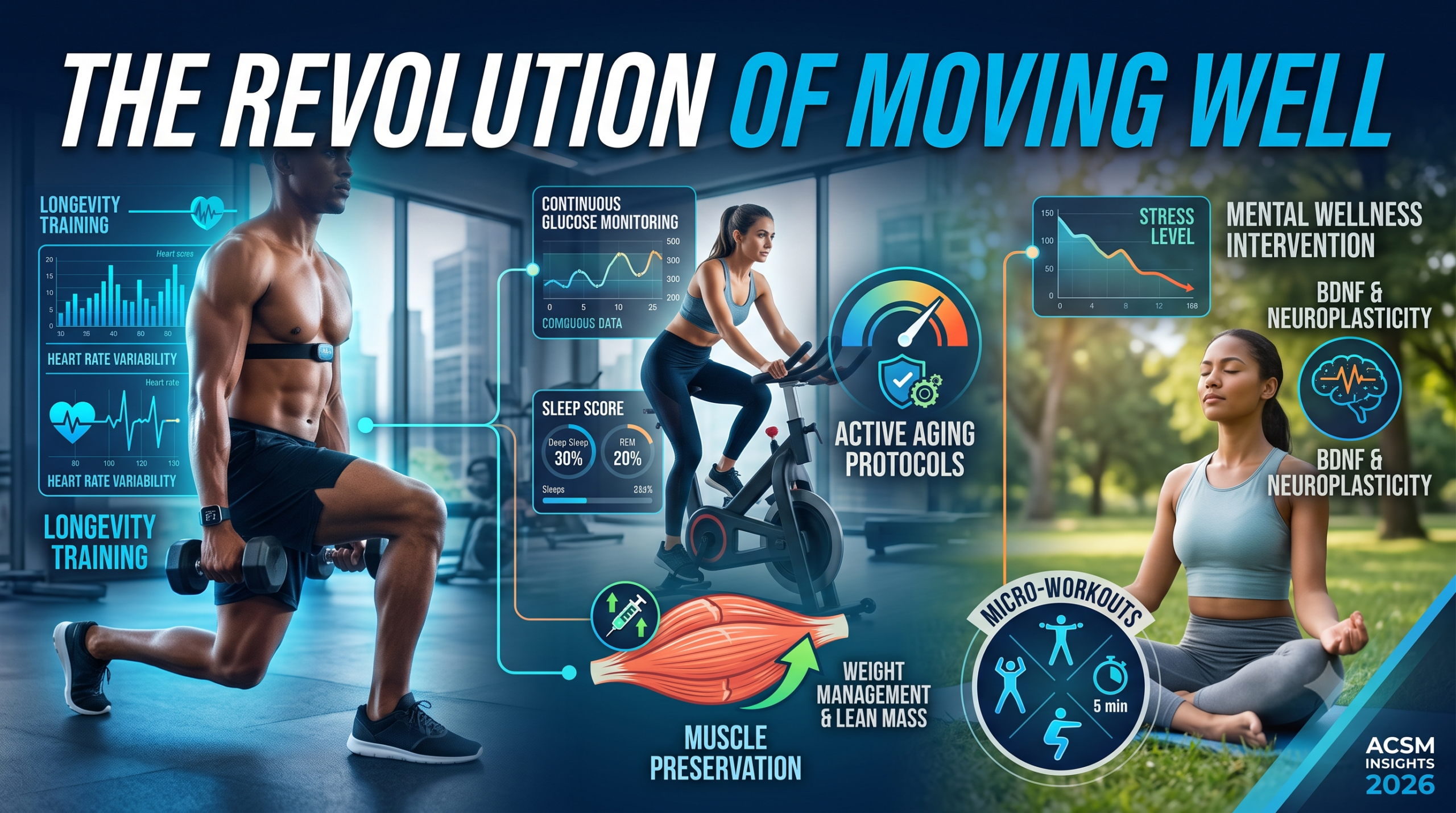
For decades, the global fitness industry operated under a predictable, seasonal loop. January brought aggressive, calorie-crushing workout manifestos; spring promised rapid beach-body transformations; and late autumn defaulted into a holding pattern. Success was measured strictly by a single, unforgiving metric: gravity’s pull on a standard bathroom scale.
In 2026, that archaic paradigm has collapsed.
Driven by breakthrough clinical research, the massive global adoption of ultra-precise consumer biometrics, and a cultural shift toward proactive preventative healthcare, fitness has been fundamentally redefined. We are no longer training merely to look smaller or perform temporarily better; we are training for healthspan—the period of life spent free from chronic disease and functional decline.
According to the latest Worldwide Fitness Trends forecast published by the American College of Sports Medicine (ACSM), the highest-ranking modalities point to an integrated ecosystem where data, functional strength, and cellular recovery converge. This comprehensive guide breaks down the core fitness trends of 2026, providing an actionable, science-backed framework to optimize your mind, body, and daily training architecture.(1)
Related Stories
 Kiat Jud Dai Workout: Benefits With Reviews and Steps
 Fitness Reserve Capacity: What It Is, Why It Matters, and How to Improve It
1. The Biometric Compass: Data-Driven Fitness & Wearable Integration.
Wearable technology has claimed the number-one spot on global fitness trend lists for nearly a decade, but the way we interact with these devices has undergone a structural evolution. In the past, smartwatches and fitness trackers were used primarily as digital scoreboards to count steps or calculate superficial “calories burned.
Today, wearables function as a clinical-grade internal compass. Advanced biosensors now seamlessly track complex physiological markers including:
- Continuous blood glucose levels.
- Blood pressure dynamics.
- Sleep architecture (deep vs. REM ratios).
- Skin temperature changes.
- Heart Rate Variability (HRV).
Shifting Focus From Intensity to Recovery.
The most significant behavioral shift in 2026 is using biometric data less as a mechanism to push harder, and more as a guide on when to back off. Instead of following a rigid, pre-written calendar, modern trainees use autoregulated programming. If an individual wakes up with a severely suppressed HRV and poor deep sleep metrics—signals that the central nervous system is under stress—their integrated fitness application or coach automatically scales back a high-intensity interval session to a restorative, Zone 2 aerobic recovery walk.
This data-driven approach eliminates the guessing game of physical progression, drastically mitigating the risks of overtraining syndrome, systemic chronic inflammation, and soft-tissue injuries.

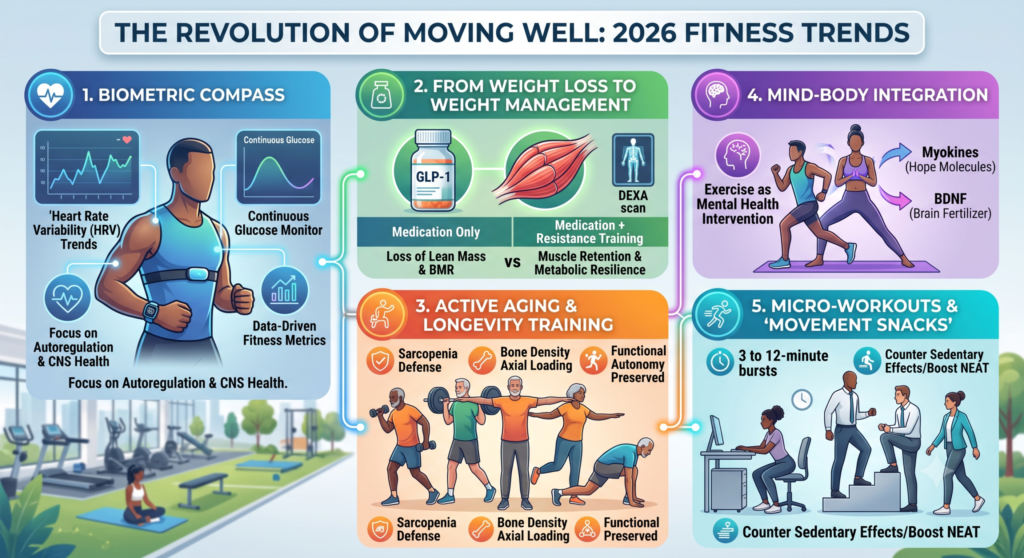
2. From Weight Loss to Weight Management: The GLP-1 & Muscle Retention Era.
One of the most drastic reclassifications in recent health history is the ACSM’s formal transition of the trend category from “Exercise for Weight Loss” to “Exercise for Weight Management.” This shift is heavily influenced by the widespread integration of advanced obesity management medications, such as GLP-1 receptor agonists.(2)
While these clinical interventions are highly effective at suppressing appetite and reducing overall adipose (fat) tissue, they present a major physiological challenge: without structured physical intervention, a significant percentage of the weight lost can come from lean skeletal muscle mass rather than fat.
Why Skeletal Muscle is Non-Negotiable.
Losing skeletal muscle mass triggers a cascade of negative metabolic consequences, including a severely depressed basal metabolic rate (BMR), compromised bone density, and a high probability of experiencing the “yo-yo effect”—rebounding to a higher body fat percentage once medication protocols change.(3)
[GLP-1 Medication / Caloric Deficit]
│
▼
[Rapid Mass Reduction]
│
┌─────────┴─────────┐
▼ ▼
[Without Exercise] [With Resistance Training]
│ │
▼ ▼
Loss of 30%+ Preservation of
Skeletal Muscle Lean Mass & BMR
│ │
▼ ▼
Metabolic Decline Metabolic Resilience
In 2026, weight management programs are strategically built around muscle preservation. Modern protocols prioritize:
- Progressive Overload Resistance Training: Stimulating myofibrillar hypertrophy (muscle fiber growth) to preserve metabolic rate.
- High-Density Protein Pacing: Pairing targeted resistance training with precise macronutrient distribution to maximize muscle protein synthesis.
- Functional Body Recomposition Testing: Moving entirely away from standard BMI (Body Mass Index) measurements and shifting toward dual-energy X-ray absorptiometry (DEXA) scans or multi-frequency bioelectrical impedance analysis to track the explicit ratio of lean mass to fat tissue.
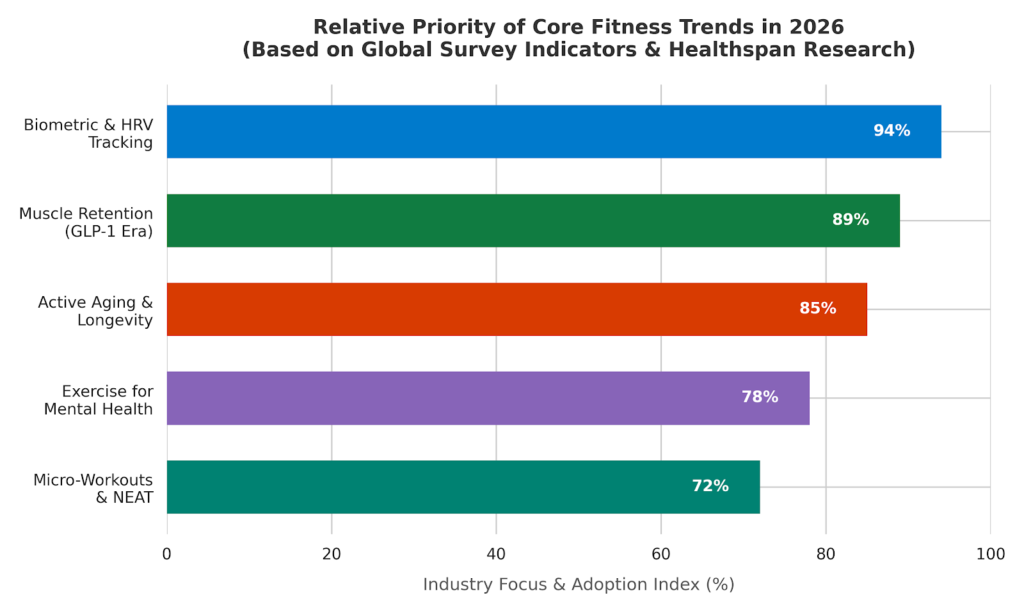
Industry priority is now strictly dominated by internal biometrics (94%) and the preservation of skeletal muscle mass (89%)—the latter heavily driven by the need to combat lean-tissue loss during modern GLP-1 weight-management treatments. Concurrently, the rise of active aging protocols (85%) and neurochemically focused mental health training (78%) underscores a society using structured movement not as a temporary cosmetic fix, but as a primary medical intervention for lifelong physical and cognitive longevity.
3. Active Aging & Longevity Training: Preserving Autonomy.
The global demographic landscape is shifting older, particularly with the aging baby boomer generation. However, today’s mature population rejects traditional, low-effort “senior fitness” formats. Instead, the focus has pivoted to highly sophisticated, evidence-based Active Aging and Longevity Training.
Clinical exercise science has definitively proven that targeted physical activity is the single most powerful intervention available to combat sarcopenia (age-related muscle wasting), osteopenia (bone density loss), and cognitive degradation.
The Core Pillars of Longevity Exercise Programming.
| Training Modality | Primary Physiological Target | Functional Real-World Benefit |
| Multi-Planar Resistance Training | Type II Fast-Twitch Muscle Fibers | Rapid force production to prevent accidental falls and maintain mobility. |
| Axial Loading Exercises | Bone Mineral Density (Osteoblast Activation) | Substantial reduction in hip, spine, and wrist fracture risks. |
| Neuromotor & Balance Drills | Vestibular & Proprioceptive Pathways | Enhanced spatial awareness and swift kinetic corrections during movement. |
| Zone 2 Cardiovascular Work | Mitochondrial Biogenesis & Efficiency | Long-term preservation of cardiovascular output and cognitive baseline. |
Rather than isolating muscle groups on static machines, longevity programming utilizes integrated movements—such as loaded carries, multi-directional lunges, and controlled rotational work—that map directly to real-world physical requirements.
4. Mind-Body Integration: Exercise as a Primary Mental Health Intervention.
The separation between physical training and psychological wellness has entirely dissolved. Exercise for mental health stands as a primary motivator for physical movement globally. National health surveys indicate that over 75% of active individuals cite emotional or psychological well-being as their primary reason for working out, outranking purely aesthetic or performance-based goals.
The Neurobiology of Movement.
When the human body undergoes structured physical stress, it releases a cascade of neurochemicals that act as a profound counter-regulatory system against anxiety and clinical depression. Movement directly upregulates:
- BDNF (Brain-Derived Neurotrophic Factor): Frequently referred to as “fertilizer for the brain,” BDNF stimulates neuroplasticity, helping to repair damaged neural pathways and improve cognitive retention.
- Endocannabinoids: Small lipid molecules that cross the blood-brain barrier to actively induce mood elevation, stress mitigation, and systemic pain reduction.
- Myokines: Specialized signaling proteins secreted by contracting skeletal muscles. Often termed “hope molecules,” myokines travel through the circulatory system to exert potent anti-depressive and anti-inflammatory effects on the central nervous system.
In 2026, this science manifests as structured hybrid classes that seamlessly pair high-intensity resistance blocks with intentional mindfulness, focused breathwork, and structured parasympathetic cooling-down protocols to optimize the human stress response.
5. Micro-Workouts & “Movement Snacks”: Overcoming Time Scarcity.
The modern professional environment demands high cognitive output and features long periods of sedentary behavior. While traditional fitness dogma insisted that a workout must last a continuous 45 to 60 minutes to be effective, exercise physiology in 2026 has validated the profound efficacy of the Micro-Workout or “Movement Snack.
A movement snack consists of short, isolated bursts of physical activity lasting anywhere from 3 to 12 minutes, strategically distributed across the workday.
The Accumulative Power of Brief Stimuli.
Peer-reviewed metabolic research demonstrates that executing three 10-minute bouts of vigorous, functional movement throughout the day yields near-identical physiological adaptations to a single, continuous 30-minute training session. These brief interventions are highly effective at:
- Breaking up prolonged physical inactivity to reverse endothelial dysfunction (stiffening of the arteries).
- Clearing postprandial blood glucose by stimulating non-exercise activity thermogenesis (NEAT).
- Sharpening immediate cognitive focus and alleviating structural lower-back or hip strain caused by prolonged sitting.
A standard movement snack might be as simple as five minutes of bodyweight squats and desk pushups between virtual meetings, or a brisk 10-minute outdoor walk paired with active mobility drills.
6. Comprehensive Blueprint: Designing Your 2026 Routine.
To synthesize these macro trends into an actionable, highly customized lifestyle protocol, your weekly training architecture must balance the stimulation of physical power with the science of systematic physiological recovery.
Below is an optimized, multi-modal weekly framework designed to build muscle mass, defend metabolic rate, and promote systemic longevity.
1.Monday: Structural Strength & Peak Force:45-60 Minutes.
Focus heavily on compound, multi-joint resistance movements (e.g., deadlifts, overhead presses, or leg presses). Prioritize progressive overload by tracking your explicit weights and reps via your digital ecosystem. Aim for 3-4 sets per movement in the 6-10 repetition range, leaving 2 repetitions in reserve.
2.Tuesday: Aerobic Base Development (Zone 2 Cardio):45-60 Minutes.
Engage in low-intensity, steady-state cardiovascular exercise such as incline walking, cycling, or rowing. Maintain a pace where your heart rate stays strictly within Zone 2 (roughly 60-70% of your maximum heart rate, or a speed where you can comfortably hold a continuous conversation but cannot sing). This drives mitochondrial efficiency and speeds up cellular recovery.
3.Wednesday: Rest, Biomarker Assessment & Deep Mobility:Rest Recovery.
No formal training. Review your weekly biometric trends (HRV, resting heart rate, and sleep metrics). Spend 15-20 minutes executing intentional mobility drills, long-axis joint traction, and deep parasympathetic breathwork to down-regulate the nervous system.
4.Thursday: Hypertrophy & Neuromotor Balance:45-60 Minutes.
Execute a full-body resistance circuit emphasizing movement quality, posture, and core stability. Integrate unilateral exercises (single-leg Romanian deadlifts, single-arm rows) to identify and correct structural imbalances while actively engaging your vestibular balance pathways.
5.Friday: Metabolic Conditioning (HIIT Snacking):20-30 Minutes.
Perform high-intensity interval training via brief, explosive bursts of work followed by full recovery periods (e.g., 30 seconds of maximal effort on an air bike followed by 90 seconds of coasting). This stimulates insulin sensitivity and spikes your post-exercise oxygen consumption (the afterburn effect).
6.Saturday & Sunday: Social Fitness, Play & Active Recovery:Varies.
Dedicate the weekend to community-driven, outdoor physical activity. Participate in local running clubs, competitive recreational sports like pickleball, or extended hiking. The primary objective here is combining cardiorespiratory training with authentic, mood-elevating social connection.
Final Takeaway: The Long-Game Paradigm.
The absolute optimization of human health requires moving far past the simplistic concepts of arbitrary calorie counting and extreme, unsustainable exhaustion. The definitive lesson of 2026’s fitness landscape is that longevity is earned through consistency, measured via precise biological data, and sustained by prioritizing skeletal muscle and recovery.
By transforming your perspective from brief, vanity-driven interventions to an analytical, longevity-focused approach, you effectively future-proof your physical body. Treat your movement as a lifelong medical prescription, leverage your wearable technology as a personal health consultant, and remember that true physical resilience is built over years, not weeks.
+3 Sources
Verywelfit has strict sourcing guidelines and relies on peer-reviewed studies, educational research institutes, and medical organizations. We avoid using tertiary references. You can learn more about how we ensure our content is accurate and up-to-date by reading our editorial policy.
- 2026 ACSM Worldwide Fitness Trends: Future Directions of the Health and Fitness Industry: ERRATUM; https://www.ovid.com/jnls/acsm-healthfitness/abstract/10.1249/fit.0000000000001130~2026-acsm-worldwide-fitness-trends-future-directions-of-the?redirectionsource=fulltextview
- Effects of GLP‐1 Receptor Agonists on Muscle Mass, Strength, and Quality in MASLD: A Systematic Review; https://pubmed.ncbi.nlm.nih.gov/7880870/
- Biological mechanisms underlying the role of physical fitness in health and resilience; https://pmc.ncbi.nlm.nih.gov/articles/PMC4142018/