











 Workout

 Meditation





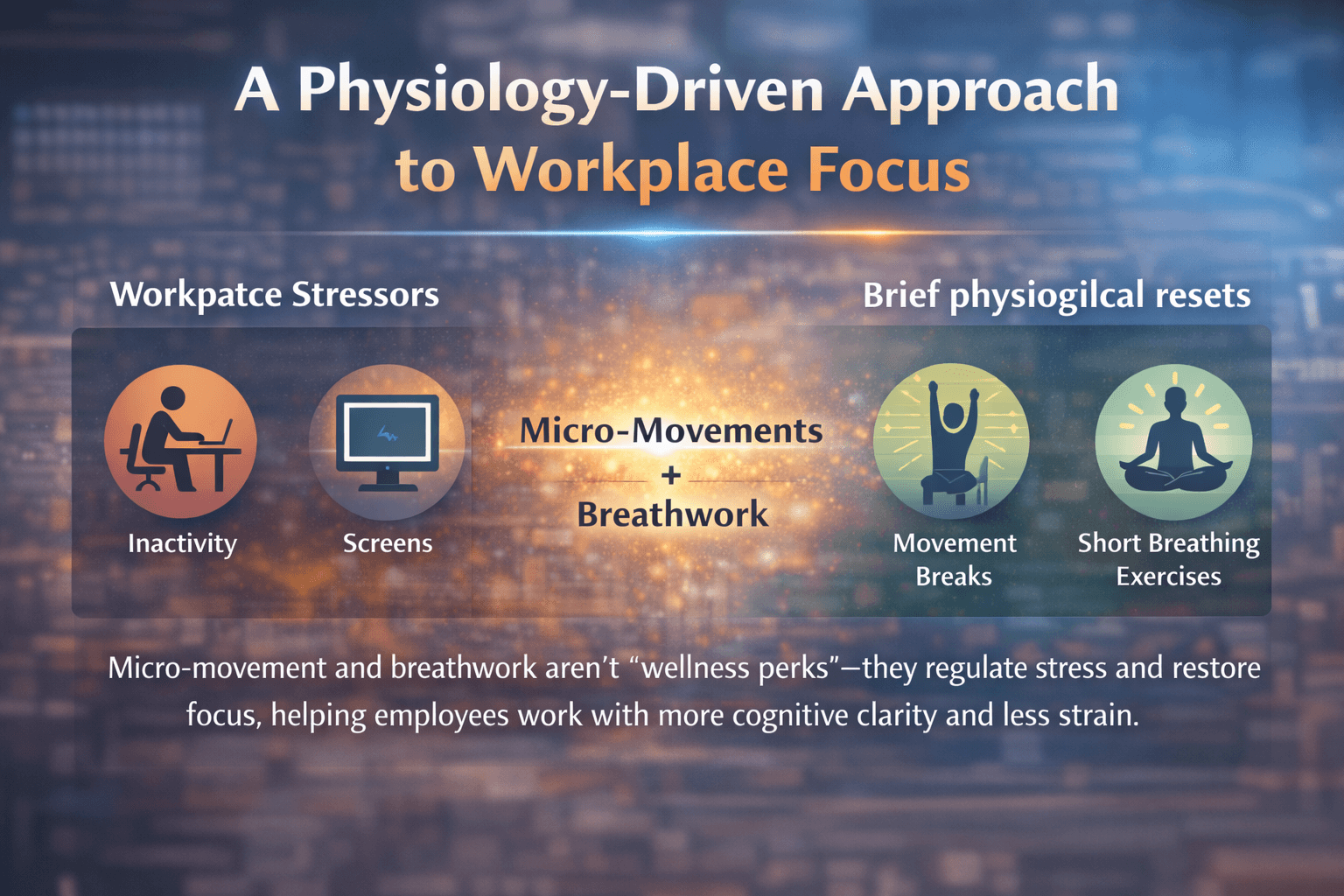
Modern workplaces have a focus problem.
Not a motivation problem.
Not a talent problem.
Not a “people don’t care anymore” problem.
A physiology problem.
Most organizations try to solve declining focus and rising burnout with:
Related Stories
 Why Does Yoga Make Me Nauseous? Understanding the Causes and How to Overcome It
 Top 6 Yoga Asanas To Improve Memory And Concentration
- productivity tools
- time-management systems
- performance pressure
- resilience workshops
And while those can help at the surface, they often miss the real bottleneck:
The human nervous system was never designed for eight hours of stillness, constant cognitive demand, and zero recovery signals.
Until leaders understand that, focus initiatives will keep falling flat.
This article lays out a practical, evidence-aligned framework for using micro-movement and breathwork to support focus at work — not as a “wellness perk,” but as an operational strategy.
Why Focus Declines in Modern Work Environments?
Most employees don’t lose focus because they’re distracted by phones or lack discipline.
They lose focus because their nervous system is operating under chronic low-grade stress.
Consider a typical workday:
- prolonged sitting
- continuous screen exposure
- high cognitive load
- frequent task switching
- social evaluation (meetings, emails, messaging apps)
To the nervous system, this feels like:
“Stay alert. Don’t move. Pay attention. Something important might happen.”
That state is useful short-term.
But when it becomes the default, the body shifts into sympathetic dominance — a mild but persistent fight-or-flight state.
The result:
- narrowed attention
- reduced working memory
- slower decision-making
- increased error rates
- mental fatigue that doesn’t resolve with breaks
At that point, no productivity hack can override biology.
The Hidden Cost of “Just Push Through”.
Many workplace cultures still reward:
- sitting longer
- skipping breaks
- powering through fatigue
On the surface, this looks like commitment.
Physiologically, it creates:
- reduced heart rate variability
- impaired prefrontal cortex function
- higher stress reactivity
- faster cognitive burnout
Employees may appear productive, but their thinking becomes:
- rigid
- reactive
- less creative
- more error-prone
This is often mistaken for “performance under pressure,” when it’s actually performance degradation under stress.
What Micro-Movement Actually Is (and Why It Works).
Micro-movement is not exercise, stretching routines, or fitness programming.
It’s small, intentional physical input designed to restore nervous system balance without disrupting work.
Typically:
- 30 seconds to 5 minutes
- desk-based or standing
- no sweating
- no equipment
- no change of clothes
From a physiological standpoint, micro-movement:
- reactivates proprioceptive sensors
- improves circulation and oxygen delivery
- reduces muscular guarding
- restores postural reflexes
This sends a simple signal to the brain:
“The body is safe. Resources can return to thinking.”
When that happens, focus improves naturally.

Why Breathwork Matters (and Why Most Workplace Versions Fail).
Breathwork is often misunderstood in professional settings.
Many people associate it with:
- intense techniques
- breath holding
- emotional release
- needing privacy
That’s not appropriate for the workplace — and it’s not necessary.
Workplace breathwork should be subtle and invisible.
The most effective pattern is also the simplest:
- nasal breathing
- slow pace
- longer exhale than inhale
This stimulates parasympathetic activity, reduces stress signaling, and improves cognitive clarity — without sedation or emotional intensity.
If breathwork causes dizziness or discomfort, it’s being done too aggressively.
The Performance Impact: Why a 15–25% Focus Improvement Is Realistic.
Applied research in occupational physiology, ergonomics, and neurocognitive performance consistently shows that short movement and breathing interventions can improve:(1)
- sustained attention
- task switching efficiency
- working memory
- error detection
When implemented consistently, organizations often see:
- longer uninterrupted focus blocks
- fewer cognitive mistakes
- reduced afternoon fatigue
- lower reliance on caffeine
These gains aren’t dramatic spikes — they’re steady improvements that compound over time.

A Practical Framework for Organizations.
Frequency.
Every 60–90 minutes during cognitively demanding work.
Duration.
2–5 minutes per reset.
Delivery Formats.
- Individual desk resets
- Post-meeting transitions
- Team-wide pauses during long sessions
- Remote-work friendly cues
What’s Required.
Nothing.
No mats. No gym. No wellness room.
Core Components of a Workplace Protocol.
1. Gentle Joint Movement.
Examples:
- neck rotations (small range)
- shoulder rolls
- ankle or foot movements
Purpose:
- reduce muscular tension
- improve sensory feedback
- decrease nervous system threat signals
2. Postural Resets.
Examples:
- seated spinal extension
- chest opening
- shoulder retraction
Purpose:
- improve breathing mechanics
- reduce neck and shoulder strain
- increase alertness without stress
3. Slow Nasal Breathing.
Example:
- inhale 4 seconds
- exhale 6 seconds
Purpose:
- reduce sympathetic activation
- improve heart rate variability
- restore cognitive clarity
Why Managers Play a Critical Role?
Micro-movement works best when it’s normalized, not mandated.
Employees take cues from leadership.
If managers:
- model short resets
- allow brief pauses
- avoid glorifying nonstop sitting
Participation increases naturally.
If managers dismiss or rush recovery, employees will suppress their needs — and pay for it later with burnout and disengagement.
Manager Training: Supporting Focus Without Increasing Pressure.
Key Reframe for Leaders.
Focus is not a personality trait.
It’s a state, influenced by:
- nervous system load
- physical stillness
- recovery opportunities
Managers don’t need to motivate harder — they need to reduce friction.
What Managers Can Actively Do?
- Encourage movement after long meetings
- Build 2-minute resets into agendas
- Normalize standing or stretching briefly
- Use language like:
- “Let’s reset for a minute”
- “Quick movement break before we continue”
These cues legitimize regulation.
What Managers Should Avoid?
- Mandatory participation
- Calling out individuals publicly
- Using breathwork as discipline or control
- Framing breaks as “rewards” instead of necessities.(2)
Regulation works best when it’s voluntary and normalized.

Team-Level Implementation Examples.
- After meetings: 2 minutes of movement before returning to tasks
- During deep work blocks: optional reset halfway through
- Remote teams: shared reminder cues or calendar prompts
- Long sessions: planned recovery pauses every 60–90 minutes
Consistency matters more than duration.
Measuring Success Without Over-Engineering It.
You don’t need complex metrics.
Common indicators:
- fewer rereads of the same material
- longer focus periods
- smoother task switching
- reduced irritability
- fewer mistakes late in the day
Qualitative feedback often sounds like:
“Work feels lighter.”
“I’m less drained.”
“I can think again in the afternoon.”
That’s success.
Addressing Common Concerns.
“Won’t this reduce productivity?”
No. It typically increases effective working time.
“Is this replacing exercise?”
No. Different goal, different system.
“What if people don’t participate?”
That’s fine. Voluntary adoption still shifts culture.
“Is this evidence-based?”
Yes — grounded in nervous system physiology and occupational research.
The Bigger Organizational Picture.
Burnout isn’t solved by resilience training alone.
It’s solved by changing daily inputs:
- movement
- breathing
- recovery cues
Organizations that support nervous system regulation see:
- improved focus
- better collaboration
- fewer stress-related errors
- more sustainable performance
This isn’t soft.
It’s strategic.
Final Thought for Leaders and Teams.
Focus doesn’t come from pressure.
It comes from supporting the body that does the thinking.
Micro-movement and breathwork don’t add more to the workday.
They remove interference.
And when interference drops, clarity returns — quietly, reliably, and sustainably.
+2 Sources
VerywelFit has strict sourcing guidelines and relies on peer-reviewed studies, educational research institutes, and medical organizations. We avoid using tertiary references. You can learn more about how we ensure our content is accurate and up-to-date by reading our editorial policy.
- Effects of 7‐minute practices of breathing and meditation on stress reduction; https://pmc.ncbi.nlm.nih.gov/articles/PMC10917090/
- “Give me a break!” A systematic review and meta-analysis on the efficacy of micro-breaks for increasing well-being and performance; https://pmc.ncbi.nlm.nih.gov/articles/PMC9432722/