















 Workout

 Meditation






The 75 Soft Challenge is a 75-day lifestyle and wellness challenge designed around consistency rather than extreme restrictions. It became popular as a more flexible alternative to the highly demanding 75 Hard Challenge.
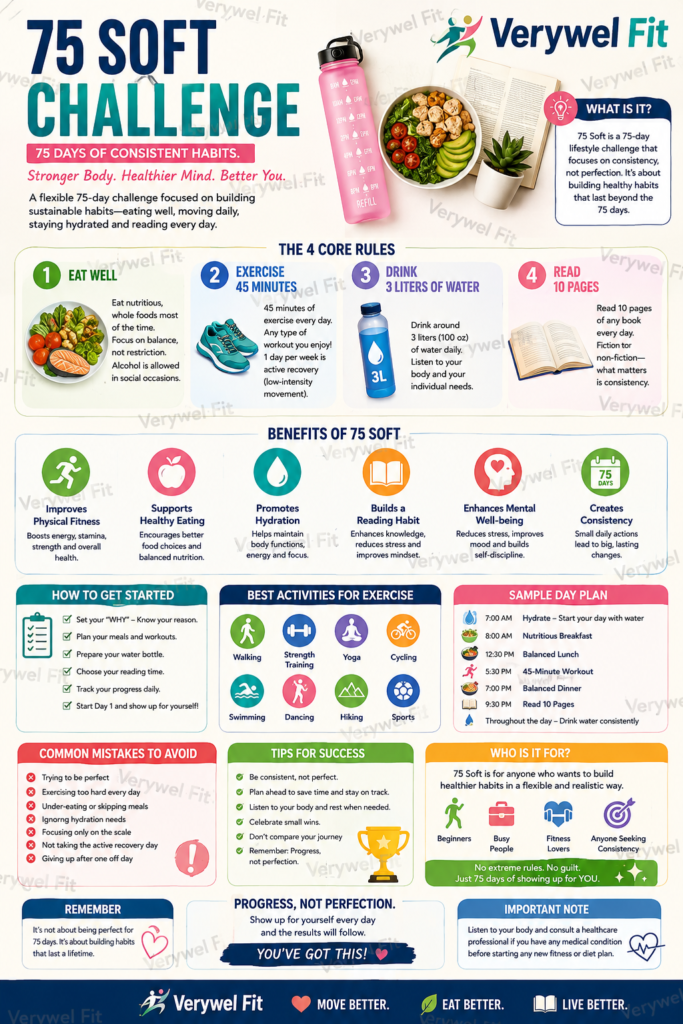
Unlike 75 Hard, the commonly circulated version of 75 Soft generally emphasizes eating well, exercising for 45 minutes a day with one active-recovery day each week, drinking around 3 liters of water daily, and reading 10 pages of a book each day. Importantly, the commonly described version does not require restarting from Day 1 after a missed task.
However, there is no single universally standardized 75 Soft rulebook. Different websites and communities have modified the challenge by adding progress photos, changing nutrition requirements, or adjusting exercise and hydration targets.
That means the healthiest way to approach 75 Soft is not to treat it as a rigid test of willpower. Instead, it can be viewed as a structured 75-day opportunity to build sustainable habits around movement, nutrition, hydration and personal development.
Related Stories
 Wall Plank Exercise: Benefits, How To Do and Variations
 Unlocking the Power of Pilates Bars
What Are the 75 Soft Challenge Rules?
The most commonly cited version includes four core habits.
1. Eat Well.
The first rule is generally described as eating well and limiting alcohol to social occasions.
Unlike many restrictive fitness challenges, 75 Soft does not prescribe one specific diet. That flexibility can make it easier to adapt to different dietary preferences and lifestyles.
A practical interpretation could include:

- Eating a variety of vegetables and fruits
- Choosing minimally processed foods regularly
- Including adequate protein
- Consuming whole grains or other nutrient-dense carbohydrates
- Including healthy sources of fat
- Limiting excessive highly processed foods
- Eating appropriate portions
- Planning meals around your lifestyle
The important word is sustainable.
Eating well does not mean eating perfectly.
A healthy diet can include foods you enjoy. Turning 75 Soft into a highly restrictive diet can undermine the very sustainability that makes the challenge attractive.
2. Exercise for 45 Minutes.
The traditional 75 Soft format calls for approximately 45 minutes of exercise each day, with one day per week devoted to active recovery.
The exercise does not have to be intense.
Depending on your fitness level, goals and health status, your sessions could include:
- Walking
- Jogging
- Strength training
- Cycling
- Swimming
- Yoga
- Pilates
- Dancing
- Hiking
- Mobility training
- Recreational sports
The weekly active-recovery day is particularly important because recovery is part of training—not a failure to train.
Gentle walking, stretching, easy cycling or relaxed yoga can be appropriate examples of active recovery. Cleveland Clinic specifically recommends lower-intensity movement rather than high-intensity exercise on this day.
3. Drink Around 3 Liters of Water.
The commonly cited 75 Soft target is 3 liters of water per day, which is approximately 100 fluid ounces.
However, this number should not be treated as a universal medical requirement.
Individual fluid requirements vary according to factors such as:
- Body size
- Activity level
- Climate
- Sweating
- Diet
- Illness
- Pregnancy or breastfeeding
- Medications
- Kidney and heart health
For example, someone exercising outdoors in a hot climate may require substantially different fluid intake from someone who is sedentary in a cool environment.
Conversely, people with certain medical conditions may have individualized fluid restrictions.
Therefore, if a healthcare professional has given you specific fluid guidance, follow that guidance instead of automatically forcing yourself to reach 3 liters.
4. Read 10 Pages Every Day.
The fourth commonly cited rule is to read 10 pages of a book every day.
Unlike 75 Hard, which traditionally emphasizes nonfiction or personal-development reading, the common 75 Soft version is more flexible about what you read.
You could choose:
- Fiction
- Biography
- History
- Science
- Personal development
- Psychology
- Business
- Philosophy
- Literature
The goal is less about completing a particular type of book and more about developing a consistent reading habit.
Ten pages may sound small, but a small daily commitment is often easier to maintain than an ambitious target that quickly becomes overwhelming.
Does 75 Soft Require a Daily Progress Photo?
This is one area where versions of the challenge differ.
Some newer versions of 75 Soft include a daily progress photo, while the commonly cited four-rule version does not.
Therefore, if you are following 75 Soft, decide your rules before Day 1.
If you choose to take progress photos, you do not need to post them publicly.
You can simply keep private photographs for your own reference.
Also remember that body weight and appearance naturally fluctuate. Changes in hydration, digestion, menstrual cycle, sodium intake and exercise can affect how the body looks from day to day.
Progress should therefore not be judged solely by photographs.
How Is 75 Soft Different From 75 Hard?
The biggest difference is rigidity.
75 Hard generally requires two 45-minute workouts every day, a specific water target, a diet with no alcohol or cheat meals, daily progress photos and reading requirements. Missing a requirement traditionally means restarting the challenge.
75 Soft is intended to be more flexible. The commonly described version uses one 45-minute workout, includes an active-recovery day, allows greater dietary flexibility and does not require starting over after a missed day.
| Feature | 75 Soft | 75 Hard |
|---|---|---|
| Duration | 75 days | 75 days |
| Exercise | 45 minutes daily, with active recovery | Two 45-minute workouts daily |
| Diet | Eat well; flexible interpretation | Strict chosen diet |
| Alcohol | Common version permits social occasions | No alcohol |
| Water | Commonly 3 liters | Commonly 1 gallon |
| Reading | 10 pages | 10 pages of nonfiction |
| Missed task | Generally continue | Traditionally restart |
| Overall approach | Flexible | Highly rigid |
The distinction matters because a challenge is only useful if it is appropriate for the person doing it.
Potential Benefits of the 75 Soft Challenge.
The 75 Soft Challenge itself has not been established as a medically validated intervention that guarantees specific health outcomes.
However, the individual habits included in the challenge are broadly aligned with several healthy lifestyle principles.
1. Encourages Regular Physical Activity.
Regular movement is an important component of cardiovascular health, muscular fitness, mobility and overall well-being.
The advantage of 75 Soft is that exercise does not have to mean intense gym training.
A 45-minute walk can be meaningful physical activity for someone who is currently sedentary.
Someone else might prefer strength training or swimming.
This flexibility can make the challenge more approachable for beginners.
2. Builds Consistency.
Perhaps the biggest psychological appeal of 75 Soft is its emphasis on repetition.
Instead of asking, “Can I completely transform my life in one week?” the challenge asks you to repeatedly perform several manageable behaviors.
This can encourage people to think about health as a collection of daily actions rather than a short-term diet.
3. May Encourage Better Eating Habits.
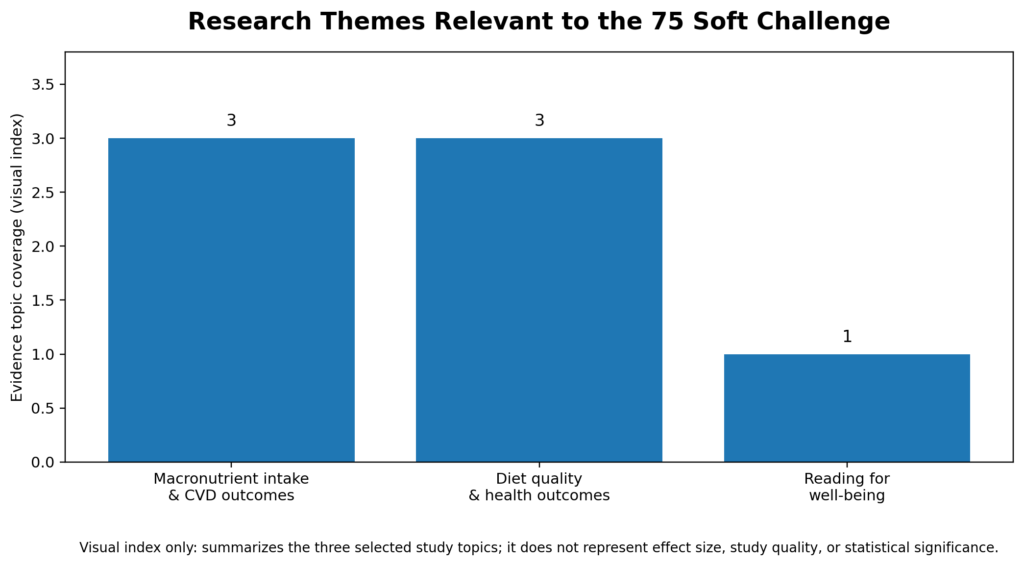
The “eat well” rule can encourage people to become more conscious of their food choices.(1),(2)
Rather than following an extreme elimination diet, participants can focus on practical behaviors such as:
- Preparing meals at home
- Eating more vegetables
- Adding protein to meals
- Planning snacks
- Reducing excessive sugary drinks
- Eating mindfully
The exact nutritional strategy should be individualized.
4. Encourages Hydration Awareness.
Many people simply forget to drink fluids regularly.
A hydration goal can encourage people to pay more attention to their fluid intake.
However, the 3-liter number should be treated as a challenge convention rather than a universal medical prescription.
5. Creates a Reading Habit.
Reading 10 pages a day can provide a structured opportunity to spend time away from constant digital stimulation.(3)
The mental benefits of reading depend on the material, the individual and how reading is incorporated into daily life.
Still, making reading a regular habit can be a useful personal-development goal.
6. Provides Structure.
People often struggle with vague goals such as:
“I want to become healthier.”
75 Soft turns that broad intention into concrete daily behaviors.
Instead of simply wanting to be healthier, a participant might decide:
- I will walk for 45 minutes.
- I will prepare balanced meals.
- I will drink fluids regularly.
- I will read before bed.
Specific behaviors are easier to track than vague intentions.
Is 75 Soft Good for Weight Loss?
It can support habits associated with weight management, but it is not specifically a weight-loss program.
Weight change is influenced by energy intake, energy expenditure, body composition, genetics, medications, sleep, stress, hormones and other factors.
The challenge does not guarantee fat loss.
A person may lose weight if their new eating and activity habits create an appropriate energy deficit, while another person may experience little or no weight change.
That does not necessarily mean the challenge has failed.
Improvements in:
- Strength
- Fitness
- Mobility
- Energy
- Sleep
- Food quality
- Exercise consistency
can be valuable even when the scale remains relatively stable.
Can Beginners Do the 75 Soft Challenge?
Yes, but beginners should modify the challenge according to their current fitness level.
Someone who has been inactive should not suddenly begin intense 45-minute workouts seven days a week.
A safer progression might look like:
Week 1: 20–30 minutes of comfortable walking or beginner exercise.
Week 2: Gradually increase duration.
Week 3 onward: Build toward longer sessions as tolerated.
The exact progression depends on age, fitness, health history and goals.
The “45 minutes” should not become an excuse to exercise through significant pain.
What Counts as Exercise During 75 Soft?
The challenge is intentionally flexible.
Potential options include:
Walking.
Walking is an accessible form of physical activity and can be particularly useful for beginners.
Strength Training.
Strength training can help develop muscular strength and physical function.
Sessions can include:
- Squats
- Lunges
- Push-ups
- Rows
- Hip hinges
- Core exercises
Exercises should be appropriate for your fitness level.
Yoga.
Yoga can combine mobility, balance, strength and relaxation depending on the style.
Cycling.
Indoor or outdoor cycling can provide cardiovascular exercise without requiring running.
Swimming.
Swimming can provide a full-body aerobic workout while reducing impact on the joints.
Dancing.
Dance is another way to make movement enjoyable rather than treating exercise as punishment.
What Is Active Recovery?
Active recovery means performing low-intensity movement instead of complete inactivity.
Examples include:
- Easy walking
- Gentle cycling
- Light stretching
- Relaxed yoga
- Mobility exercises
The purpose is not to set a personal record.
It is to keep moving while allowing the body to recover from harder training.
If you are extremely fatigued, injured or unwell, however, complete rest may be more appropriate than forcing an active-recovery session.
What Should You Eat During 75 Soft?
There is no single “75 Soft diet.”
A practical approach is to create a simple nutrition framework that you can maintain for 75 days.
For example:
Breakfast: Protein + fruit + whole-grain or other nutrient-dense carbohydrate
Lunch: Protein + vegetables + carbohydrate + healthy fat
Snack: Fruit, yogurt, nuts or another satisfying option
Dinner: Protein + vegetables + carbohydrate
The exact foods should reflect your cultural preferences, budget, dietary requirements and health goals.
You do not need to eliminate carbohydrates, completely avoid desserts or follow a fashionable diet simply because you are participating in a challenge.
Should You Avoid Alcohol During 75 Soft?
The commonly cited version permits alcohol during social occasions.
However, “allowed by the challenge” does not mean “healthy.”
Alcohol carries health risks, and consuming less—or not drinking—is generally lower risk.
If you choose to drink, keep your consumption within applicable public-health guidance and consider whether alcohol interferes with your sleep, exercise, nutrition or goals.
People who should avoid alcohol entirely should not use the 75 Soft rule as a reason to drink.
Is Drinking 3 Liters of Water Safe for Everyone?
No.
This is one of the most important safety considerations.
The 3-liter target commonly associated with 75 Soft is not appropriate for everyone.
Excessive fluid intake can, in certain circumstances, contribute to dangerously low blood sodium levels, particularly when large amounts are consumed rapidly.
People with conditions affecting fluid balance may also have individualized restrictions.
If you have kidney disease, heart failure, liver disease, take medications affecting fluid balance, or have been instructed to restrict fluids, speak with your healthcare professional before adopting a fixed hydration target.
Do not force yourself to drink water simply to check a challenge box.
Common Mistakes People Make With 75 Soft.
Mistake 1: Treating “Soft” Like a Competition.
The purpose is consistency—not proving that you can suffer more than everyone else.
Mistake 2: Exercising Too Hard.
Forty-five minutes of exercise does not mean 45 minutes of maximum effort.
Mistake 3: Under-Eating.
Trying to lose weight rapidly by drastically reducing food intake can increase fatigue and make exercise harder.
Mistake 4: Treating 3 Liters as Mandatory for Everyone.
Hydration needs vary.
Mistake 5: Becoming Obsessed With the Scale.
Weight is only one measure of progress.
Mistake 6: Ignoring Recovery.
Muscles and connective tissues need recovery after training.
Mistake 7: Turning One Missed Day Into Failure.
One missed habit does not erase everything you accomplished before it.
The commonly described 75 Soft format specifically differs from 75 Hard by allowing participants to continue after a missed task rather than restarting.
What Happens If You Miss a Day?
This is where 75 Soft can be considerably more forgiving.
In the commonly cited version, missing a requirement does not mean returning to Day 1. You simply continue the challenge.
For example, suppose you complete 20 successful days but become sick on Day 21.
You do not need to punish yourself by restarting.
Instead:
- Recover.
- Identify what interrupted your routine.
- Modify your plan if necessary.
- Continue when you are ready.
This approach can prevent the “all-or-nothing” mentality that makes many restrictive challenges difficult to sustain.
How to Make 75 Soft More Sustainable?
Set Realistic Exercise Goals.
If you are new to exercise, gradually build your workload.
Prepare Food in Advance.
Meal preparation can reduce reliance on convenience foods when your schedule becomes busy.
Carry a Water Bottle.
This can make regular hydration easier without constantly thinking about it.
Read Before Bed.
Replacing some evening scrolling with reading can make the 10-page goal easier.
Schedule Your Active Recovery Day.
Choose a predictable day each week for lower-intensity movement.
Track Habits, Not Just Results.
A simple checklist can show whether you are consistently performing your intended behaviors.
A Sample 75 Soft Day.
A typical day might look like this:
7:00 AM: Wake up and drink fluids according to your hydration needs.
8:00 AM: Balanced breakfast.
12:30 PM: Nutritious lunch.
5:30 PM: 45-minute strength-training session.
7:00 PM: Balanced dinner.
9:30 PM: Read 10 pages.
This is only an example.
Your routine might look completely different depending on your job, family responsibilities, training schedule and lifestyle.
The challenge should fit your life rather than forcing your entire life to revolve around the challenge.
Who Should Be Careful With 75 Soft?
Speak with a qualified healthcare professional before starting a new exercise or dietary program if you have:
- A significant cardiovascular condition
- Kidney disease
- Diabetes requiring individualized exercise or nutrition planning
- A major musculoskeletal injury
- A history of eating disorders
- A condition requiring fluid restriction
- Pregnancy-related exercise considerations
- Another condition that affects exercise tolerance
People with a history of disordered eating should be particularly cautious with rigid food rules and weight-focused challenges.
In such situations, a personalized plan developed with an appropriate healthcare professional may be more beneficial than following a social-media challenge.
Is 75 Soft Better Than 75 Hard?
There is no universal answer.
For some people, the rigid structure of 75 Hard may feel motivating.
For others, its strict restart rules and demanding exercise requirements may encourage an unhealthy all-or-nothing mindset.
75 Soft offers more flexibility and may be easier to integrate into ordinary life.
But the best approach is the one that promotes healthy behaviors without creating unnecessary physical or psychological stress.
You do not need to complete a viral challenge to become healthier.
You can simply adopt the useful components and leave out the parts that do not fit your needs.
Frequently Asked Questions.
1. What is the 75 Soft Challenge?
It is a 75-day wellness challenge centered on habits such as eating well, exercising, staying hydrated and reading daily.
2. How many days is 75 Soft?
The challenge lasts 75 days.
3. Do you have to restart if you miss a day?
The commonly cited version does not require a restart after a missed task. You continue with the challenge.
4. Can you eat carbs during 75 Soft?
Yes. There is no universal rule requiring carbohydrate elimination. A balanced eating pattern can include nutrient-dense carbohydrate sources.
5. Can you have a cheat meal?
There is no standardized definition of a “cheat meal” in the common 75 Soft rules. It is better to focus on an overall balanced eating pattern rather than categorizing foods as morally good or bad.
6. Can walking count as exercise?
Yes. Walking is commonly considered an appropriate form of movement for 75 Soft, including as active recovery.
7. Can yoga count?
Yes. Yoga can be used as exercise or lower-intensity active recovery depending on the style and intensity.
8. Do I have to go to the gym?
No. The challenge does not require gym membership.
9. Do I have to drink exactly 3 liters?
No fixed hydration number is appropriate for every person. The 3-liter target is a commonly cited challenge rule, but individual fluid needs vary.
10. Is 75 Soft suitable for weight loss?
It may encourage habits that support weight management, but it does not guarantee weight loss.
11. Can I do 75 Soft if I’m a beginner?
Yes, but exercise intensity and duration should be adapted to your current ability.
12. Is 75 Soft scientifically proven?
The 75 Soft Challenge as a whole is not a scientifically validated medical program. Its individual components—regular physical activity, healthy eating, adequate hydration and reading—are general lifestyle behaviors, but completing the challenge does not guarantee specific health outcomes.
Final Takeaway.
The 75 Soft Challenge is best viewed as a flexible 75-day habit-building framework rather than a strict test of physical endurance.
The commonly cited version focuses on four habits: eat well, exercise for about 45 minutes a day with one active-recovery day each week, drink around 3 liters of water, and read 10 pages daily. Unlike 75 Hard, the common version does not require participants to restart the entire challenge after a missed day.
Its greatest strength is also its greatest opportunity for customization. Instead of obsessing over perfect compliance, participants can use the 75 days to develop realistic routines that continue after the challenge ends.
However, the rules should be adapted when necessary. The 3-liter hydration target is not appropriate for everyone, and 45 minutes of exercise every day should not mean high-intensity training without adequate recovery.
The healthiest interpretation of 75 Soft is therefore simple:
Move consistently. Eat nourishing foods. Hydrate appropriately. Give your mind time to learn and rest. Recover when necessary. And don’t let one imperfect day convince you that you’ve failed.
A 75-day challenge is ultimately valuable only if the habits you build during those 75 days can continue into Day 76 and beyond.
+3 Sources
Verywelfit has strict sourcing guidelines and relies on peer-reviewed studies, educational research institutes, and medical organizations. We avoid using tertiary references. You can learn more about how we ensure our content is accurate and up-to-date by reading our editorial policy.
- Dietary Macronutrient Intake and Cardiovascular Disease Risk and Mortality: A Systematic Review and Dose-Response Meta-Analysis of Prospective Cohort Studies; https://pubmed.ncbi.nlm.nih.gov/38201983/
- Diet Quality as Assessed by the Healthy Eating Index, Alternate Healthy Eating Index, Dietary Approaches to Stop Hypertension Score, and Health Outcomes: An Updated Systematic Review and Meta-Analysis of Cohort Studies; https://pubmed.ncbi.nlm.nih.gov/29111090/
- Reading for wellbeing: a realist review of evidence; https://pubmed.ncbi.nlm.nih.gov/41321266/