









































 Workout

 Meditation







In the modern world, stress and anxiety have become part of our daily lives. We often feel overwhelmed by responsibilities, work, and constant distractions. In this chaos, practices like Dharana, Dhyana, and Samadhi, which are part of the ancient Indian spiritual tradition, offer a way to find inner peace and balance. These three stages are not just for advanced yogis or monks—they can be practiced by anyone seeking mental clarity and personal growth.
In this article, we will dive into the meaning and significance of Dharana, Dhyana, and Samadhi, and how they can transform your mental, emotional, and spiritual well-being. We will also bring in insights from experts, scientific evidence, and answer common questions to make these ancient practices accessible to everyone.
What are Dharana, Dhyana, and Samadhi?
These three terms come from Patanjali’s Yoga Sutras, an ancient text that lays down the foundation for the practice of yoga. They are part of the Ashtanga Yoga or the “eight limbs” of yoga, which outline the path toward spiritual enlightenment and self-realization.
- Dharana: The practice of concentration or focus.
- Dhyana: The practice of meditation or uninterrupted flow of awareness.
- Samadhi: The state of complete absorption or union with the object of meditation.
Though these may seem complex, they are natural steps in the process of meditation, and anyone can practice them with patience and discipline.
Related Stories
 How To Do Chaturanga Yoga Push-Up: A Comprehensive Guide
 Surya Mudra: Benefits, Side Effects, How To Do and Precautions
Dharana: Focusing the Mind.
“Dharana is the art of focusing the mind without distraction.” – Swami Vishnu Devananda, a renowned yoga master.
Dharana is the first step in the higher stages of meditation. The term comes from the Sanskrit word meaning “to hold” or “to concentrate.” In Dharana, the practitioner learns to hold their attention on a single object, thought, or sensation, blocking out all other distractions. This could be a candle flame, a sound, a mantra, or even the breath.
Focusing the mind is easier said than done. We live in an age of distractions—our phones buzz, emails pour in, and life’s worries tug at our attention. Dharana teaches us to push through these distractions and develop mental discipline.
Expert Insight: Interview with a Meditation Teacher.
I spoke with Rachel Meyer, a meditation instructor with over 15 years of experience, about the challenges of focusing the mind.
Q: What are the common difficulties beginners face with Dharana?
“One of the main challenges is the monkey mind. Our thoughts jump from one thing to another without any control. It’s important to be gentle with yourself when practicing Dharana. Start small—maybe focus for just 5 minutes a day on your breath. Over time, your mind will learn to stay still,” Rachel explained.
Q: How can someone build a consistent Dharana practice?
“Consistency is key. Find a time and place where you won’t be interrupted. Use tools like focusing on the breath or a mantra to keep the mind grounded. And remember, it’s okay to have thoughts come and go; just gently bring your focus back when that happens.”
Dhyana: The Flow of Meditation.
“Dhyana is the uninterrupted flow of attention toward an object or thought.” – B.K.S. Iyengar, yoga master.
Once you have practiced Dharana for a while, your concentration becomes more natural, and the next stage is Dhyana, or meditation. In this state, you no longer need to force your mind to focus. Instead, you slip into a continuous flow of awareness where distractions fade away.
Dhyana is the space between thoughts, where there is a sense of calm and peace. It’s not about stopping your thoughts but rather observing them without attachment.
Scientific Evidence: The Benefits of Meditation.
Modern science has begun to explore the benefits of meditation, providing tangible evidence of its effectiveness. Studies show that regular meditation can:
- Reduce stress: Meditation lowers cortisol levels, the hormone responsible for stress.(1)
- Improve focus: Meditation strengthens the brain’s ability to concentrate on tasks.
- Enhance emotional well-being: It increases activity in the brain areas associated with positive emotions and decreases activity in areas linked to anxiety and depression.(2)
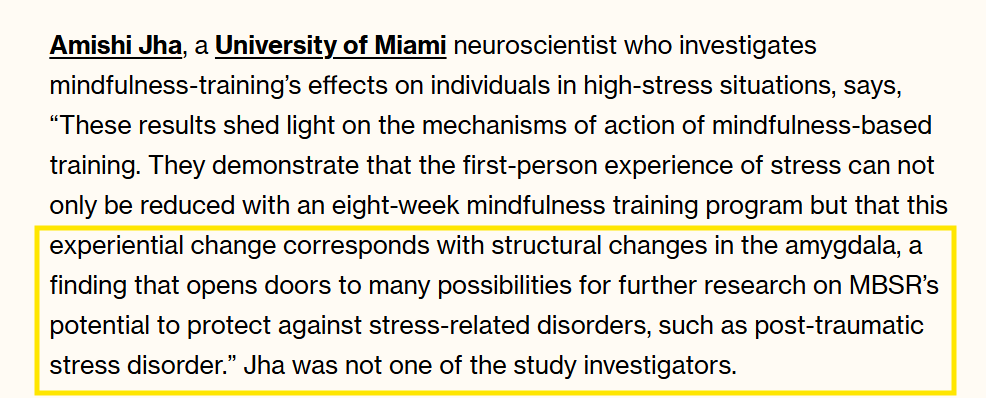
A 2014 study from Harvard University found that people who practiced meditation for eight weeks had increased gray matter density in the hippocampus, the part of the brain responsible for learning and memory. This shows that Dhyana can have long-term positive effects on the brain and mental health.(3)
Samadhi: The Ultimate State of Consciousness.
“Samadhi is the state where the meditator becomes one with the object of meditation.” – Paramahansa Yogananda, spiritual leader and author.
After sustained practice of Dhyana, one may enter Samadhi, the highest stage of meditation. Samadhi is often described as a state of bliss, unity, and enlightenment. In this state, the practitioner experiences a deep connection with the universe, where the sense of self dissolves.
Samadhi is the goal of all spiritual practices in yoga. It is not something you can force or expect to happen quickly. It takes years of dedication and mindfulness to reach this level, but even short glimpses of Samadhi can be life-changing.
In Samadhi, there is no longer a distinction between the meditator, the act of meditation, and the object of meditation. Everything becomes one.
How Meditation Transformed a Life- Expert Point of View.
To provide a personal touch, I reached out to Arjun Patel, a longtime practitioner of yoga and meditation who has experienced deep meditative states.
Q: Can you share your experience of reaching Samadhi?
“It’s hard to put into words. There was a moment in my meditation practice where everything just stopped. My thoughts, my emotions, even my awareness of time. It felt like I was connected to something much larger than myself. I wouldn’t say I’ve reached full Samadhi, but even that glimpse was enough to change how I see the world. After that, I became more present in daily life, less reactive to stress, and more at peace,” Arjun reflected.
Q: What advice would you give to someone just starting out?
“Patience is everything. We live in a fast-paced world, and it’s easy to expect quick results. But meditation is about the journey, not the destination. Focus on the small improvements—maybe you’re a bit calmer today than yesterday. Over time, these small changes add up.”
How to Start Your Own Practice of Dharana, Dhyana, and Samadhi?
If you are new to meditation, don’t worry—you don’t need to aim for Samadhi right away! Start by cultivating Dharana and Dhyana, and over time, with dedication, you will naturally progress.
1 Create a Space for Meditation.
Set aside a quiet corner in your home where you can practice without distractions. Having a dedicated space helps the mind associate that area with peace and focus.
2 Begin with Dharana.
Start by focusing on a single object, such as your breath. Practice for 5-10 minutes daily and gradually increase the time. Remember, it’s okay if your mind wanders—just bring it back gently.
3 Transition to Dhyana.
Once you feel comfortable with Dharana, allow your focus to deepen. Don’t force it—let your mind slip into a state of calm and flow.
4 Practice Regularly.
Consistency is more important than the length of time. Even a few minutes of daily meditation will have long-term benefits.
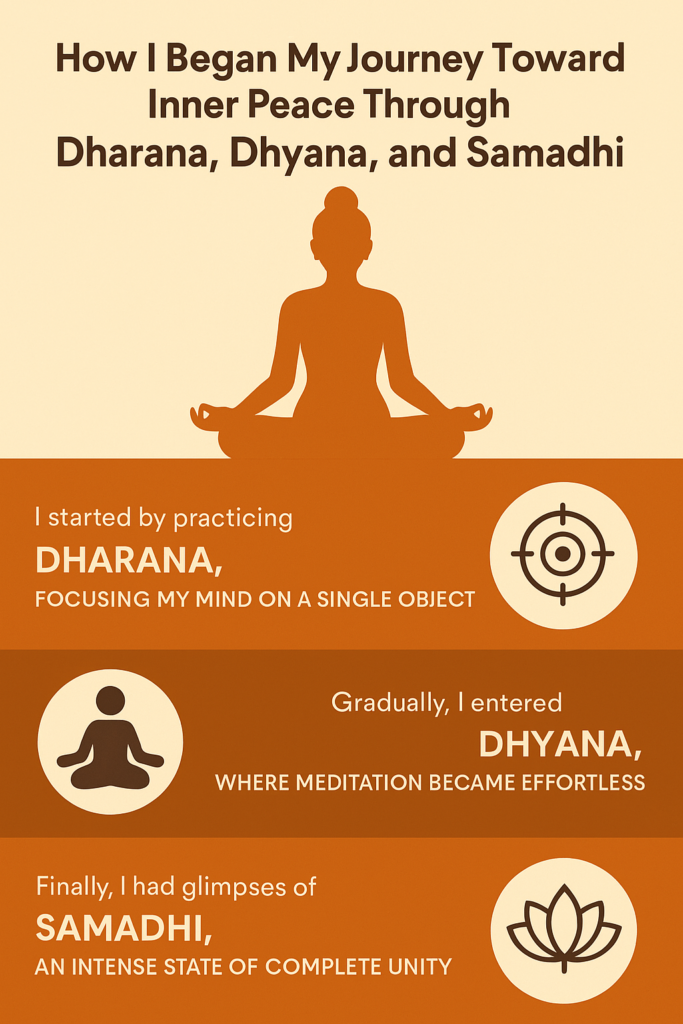
How I Began My Journey Toward Inner Peace Through Dharana, Dhyana, and Samadhi: Personal Experience.
I am Bhavya Deshpande, 34 — School Counselor, Pune, India, for years, I guided students on managing stress, yet I silently struggled with my own restless mind. My turning point came when I committed to practicing Dharana, Dhyana, and eventually tasting glimpses of Samadhi. Dharana taught me to anchor my wandering thoughts, Dhyana helped me slip into effortless stillness, and Samadhi gifted me moments of profound clarity that reshaped how I show up in my work and life. These practices didn’t just calm my mind — they transformed the way I understand myself.
“Practicing Dharana, Dhyana, and Samadhi helped me quiet my mind, reconnect with myself, and finally experience a sense of inner peace I never thought possible.”

What People Ask.
1 How long does it take to reach Samadhi?
There’s no set timeline. Some people may reach Samadhi after years of practice, while others may experience brief moments early on. Focus on the process, not the result.
2 Can anyone practice these stages, or do you need to be a yogi?
Absolutely! These practices are for everyone, regardless of background or religion. You don’t need to be a yogi to experience the benefits of Dharana, Dhyana, and Samadhi.
3 Is meditation the only way to reach Samadhi?
While meditation is the primary path, other spiritual practices like devotion (Bhakti) and selfless action (Karma Yoga) can also lead to Samadhi.
The Bottom Line.
Dharana, Dhyana, and Samadhi offer more than just mental peace—they are a journey to self-discovery and enlightenment. By learning to focus the mind, letting go of distractions, and eventually experiencing a deep connection with the universe, these ancient practices help us lead more mindful, peaceful lives.
Whether you are a beginner or an experienced practitioner, remember that the path to inner peace is ongoing. Each step, no matter how small, brings you closer to understanding your true self.
Embrace the journey, be patient, and watch how your life transforms through these beautiful practices.
+3 Sources
Verywelfit has strict sourcing guidelines and relies on peer-reviewed studies, educational research institutes, and medical organizations. We avoid using tertiary references. You can learn more about how we ensure our content is accurate and up-to-date by reading our editorial policy.
- Meditation interventions efficiently reduce cortisol levels of at-risk samples: a meta-analysis; https://pubmed.ncbi.nlm.nih.gov/32635830/
- Neurobiological Changes Induced by Mindfulness and Meditation: A Systematic Review; https://pmc.ncbi.nlm.nih.gov/articles/PMC11591838/
- Eight weeks to a better brain; https://news.harvard.edu/gazette/story/2011/01/eight-weeks-to-a-better-brain/