

































 Workout

 Meditation





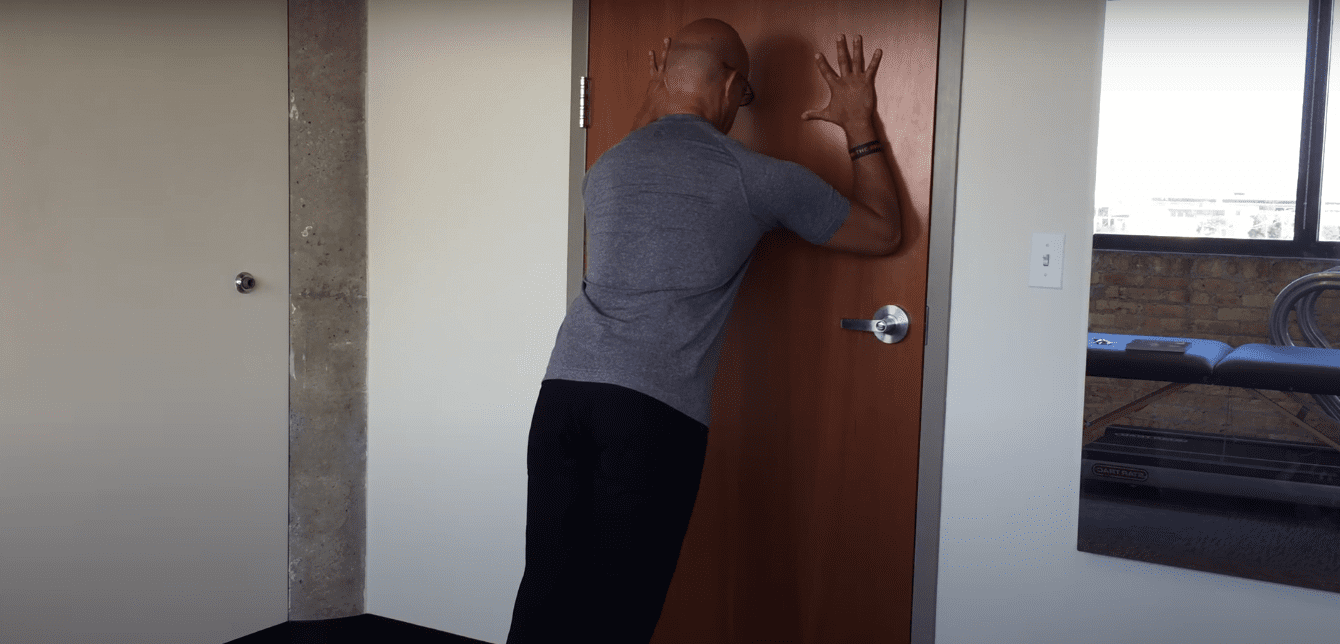
The wall plank exercise is a great way to strengthen your core muscles. It is a low-impact exercise that works the abdominals, back, and shoulders. This exercise is easy to learn and can be done in the comfort of your own home. In this article, we will walk you through the proper form and technique for performing the wall plank exercise correctly.
Benefits of Wall Plank Exercise.
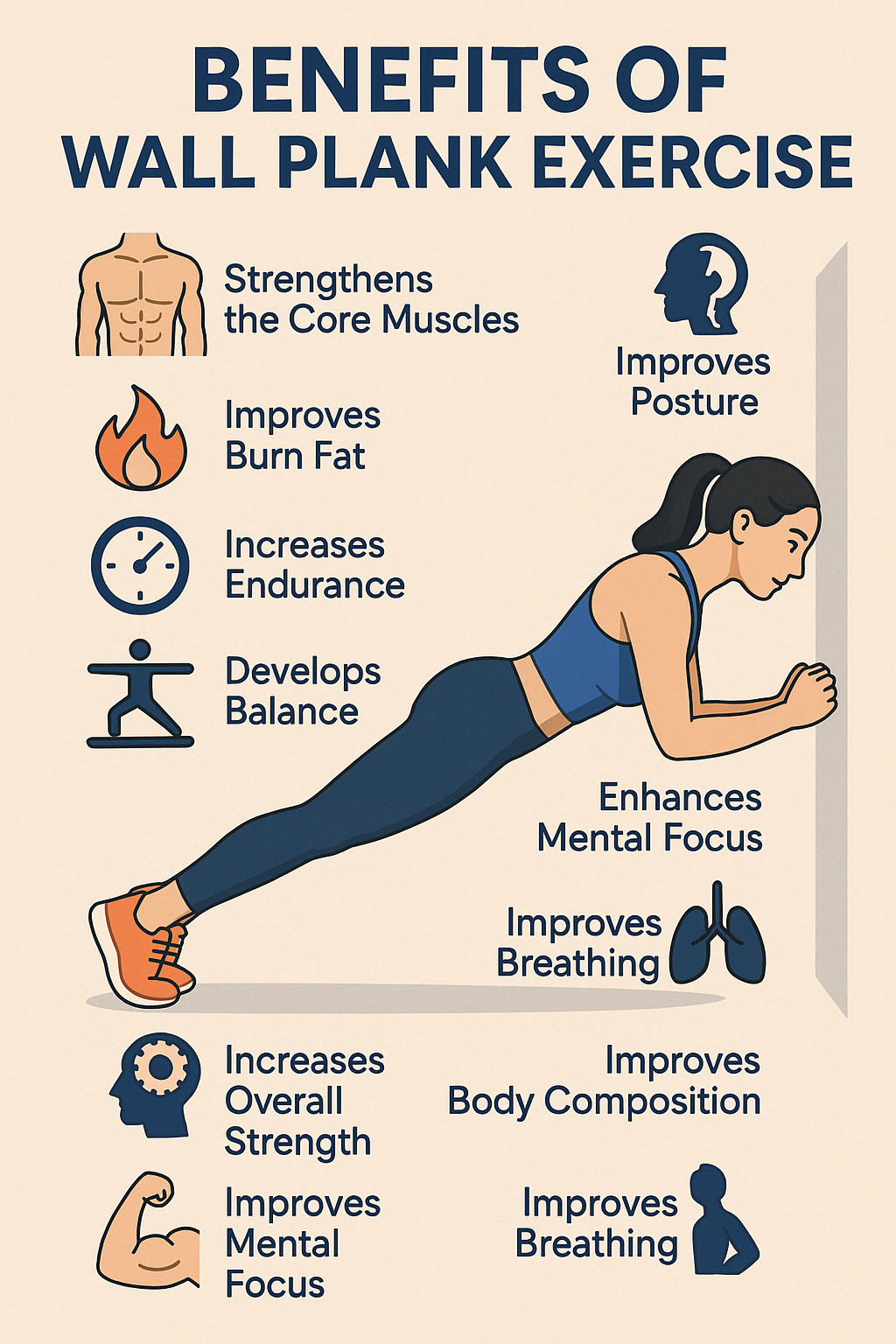
1 Strengthens the Core Muscles.
Wall plank is an excellent exercise for building core strength. It engages the muscles in the abdomen, back, hips, and glutes to keep your body stabilized while performing the exercise.
2 Improves Posture.
Doing wall plank regularly can help to strengthen the back and improve posture. It can also help to reduce lower back pain and improve spinal alignment.(1)
3 Helps To Burn fat.
Wall plank helps to burn fat by increasing the metabolic rate. As a result, it can help you to lose weight faster.
Related Stories
 What Are The Best Ways To Reduce Double Chin Quickly?
 Fitness in the Senior Years: Redefining Aging with Holistic Health Practices
4 Increases Endurance.
Doing wall plank helps to increase endurance by building muscle stamina. It can also help you to last longer during physical activities such as running and cycling.(2)

5 Develops Balance.
Doing wall plank helps to improve balance and coordination. It can also help to reduce the risk of falls and injuries when engaging in other physical activities.(3)
6 Enhances Flexibility.
Wall plank helps to improve flexibility by stretching out the muscles in the body. This can help you to perform better in other physical activities and prevent muscle strain and injuries.(4)
7 Enhances Mental Focus.
Wall plank is a great exercise for improving mental focus and concentration. Doing wall plank regularly can help to increase alertness and reduce stress levels.(5)
8 Improves Breathing.
Wall plank can help to improve breathing by strengthening the muscles used in breathing. As a result, it can help to reduce shortness of breath when performing other physical activities.(6)
9 Increases Overall Strength.
Doing wall plank regularly helps to increase overall strength and muscular endurance. As a result, it can help you to perform better in physical activities such as weightlifting and sports.
10 Improves Body Composition.
Wall plank helps to build lean muscle and burn fat. As a result, it can help to improve body composition and enhance physical performance.(7)
Wall Plank Exercise Muscle Worked.
The wall plank exercise works a variety of muscle groups, including the abdominals, back muscles, and shoulders. The abdominals are targeted as you contract your core to keep your body in the correct position.
Your back muscles are also worked as you support your body and maintain the correct posture.
Lastly, your shoulders are engaged to help you stabilize your body and keep it in the correct alignment. This exercise is great for targeting multiple muscle groups at once, making it an effective way to strengthen your core and upper body.
How to Do the Wall Plank Exercise Properly Step by Step?
Step 1. Start by facing away from the wall, with your feet slightly apart and your hands on the wall at shoulder height.
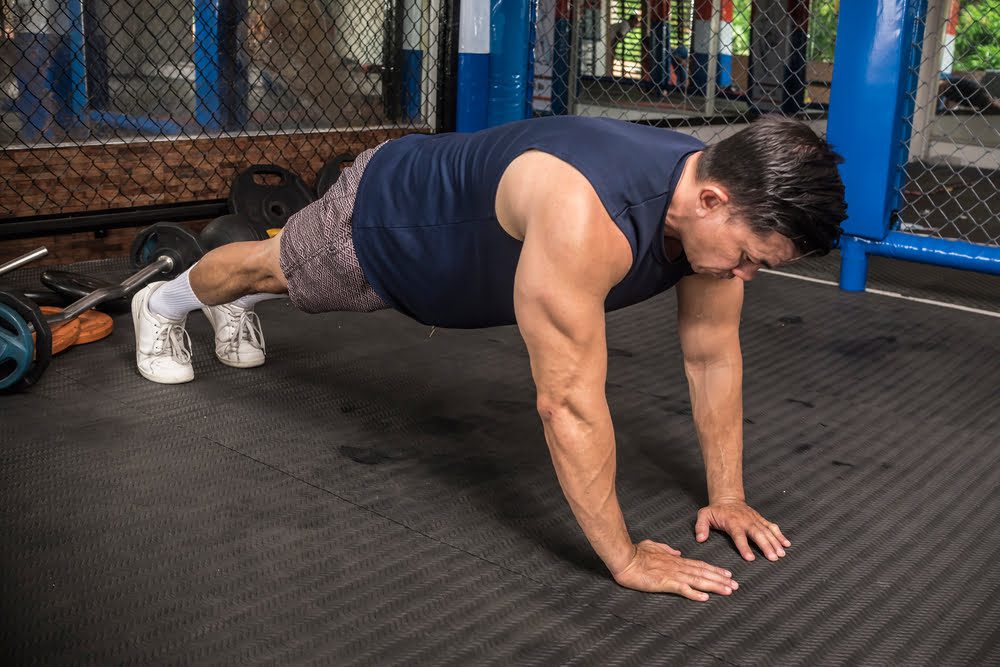
Step 2. Keeping your abs tight and your back flat, slowly lower your body into a plank position, with your arms and legs straight.
Step 3. Hold this position for 30 seconds to 1 minute, or as long as you can manage.
Step 4. To end the exercise, slowly return to the starting position, pushing up with your arms to raise your body up until you’re standing straight again.
Step 5. Repeat the exercise two to three times, resting between each repetition.
*Note. Remember, it’s important to keep your form correct throughout the exercise to avoid injuries. Make sure you keep your abs tight and your back flat, and keep your arms and legs straight for the duration of the exercise.
Variations of Wall Plank Exercise.
The wall plank exercise can be performed in a variety of ways to target different muscles and challenge your core strength. Following are some variations that can be done;
1 Offset Wall Plank.
This variation targets the obliques and helps you to build greater core stability. Begin in a standard wall plank position, with your feet shoulder-width apart, your hands shoulder-width apart, and your body in a straight line from head to heels.
Once in position, lift one leg up off the ground, hold for five seconds and then return the leg back to its starting position. Switch legs and repeat.
2 Wall Plank with Knee Drive.
For this variation, start in a wall plank position with your feet shoulder-width apart, hands shoulder-width apart and your body in a straight line from head to heels.
From here, drive your right knee towards your left elbow and hold for three seconds before returning to the start position. Repeat this motion with the other leg and continue alternating for 10-15 reps.
3 Single Arm Wall Plank.
For this variation, start in a wall plank position but this time place your hands wider than shoulder-width apart and hold a dumbbell in one hand.
Keep the weight pressed against your chest and maintain a neutral spine as you alternate between sides while maintaining the plank position.
4 Plank with Reach.
This is a great variation if you want to add more of an upper body component to the exercise. Start in the standard wall plank position, feet shoulder-width apart, hands slightly wider than shoulder-width apart and your body in a straight line from head to heels.
Reach your right hand forward and then return it to its starting position before repeating with the left hand. Continue alternating arms for 10-15 reps.
5 Sitting Wall Plank Exercise.
The Sitting Wall Plank Exercise is a great way to work on core strength and stability while also targeting the muscles of the upper and lower body. This exercise is done while sitting against a wall with your feet firmly planted on the ground. It’s important to keep your feet slightly wider than shoulder-width apart, as this will provide more stability and help prevent injury.
To begin, sit on the ground with your back up against a wall. Make sure your feet are flat on the ground and slightly wider than shoulder-width apart. Place your hands on the ground about shoulder-width apart, just beyond your hips. Keep your torso and head straight, so that your body is in one long line from head to toe.
Engage your core by pulling your belly button towards your spine and press your heels into the ground as you slowly lift your hips off the floor.
Hold this position for 30 seconds or longer if possible. You should feel your glutes, inner thighs, and core engage. To make the exercise harder, reach one arm up towards the ceiling or extend one leg out in front of you.
It’s important to remember to keep your core engaged throughout the entire exercise. The Sitting Wall Plank Exercise is an excellent way to build core strength and stability while also targeting the muscles of the upper and lower body.
*Note. These variations of the wall plank exercise will help you to build greater core strength and stability while targeting specific muscle groups. Be sure to always maintain correct form throughout each exercise and listen to your body for proper rest periods when needed.
Success Tips : Wall Plank Exercise.
1 Start Slow.
Don’t jump into wall plank exercise if you’re a beginner. Take it slow and start with just a few seconds at a time and then gradually build up your endurance.
2 Keep Your Core Engaged.
Make sure your core is always engaged while doing wall planks, as this will help you maintain proper form.
3 Don’t Forget to Breathe.
Breath slowly and steadily during the entire wall plank exercise to help keep your core engaged and your body oxygenated.
4 Find the Right Wall.
Make sure you are using a stable wall for wall plank exercises and not a wall that can move or shift during the exercise.
5 Keep Your Neck in Line With Your Spine.
Make sure you are keeping your neck in line with your spine when doing wall planks to avoid any neck strain.
6 Set a Goal.
Set a goal for yourself such as how many seconds or how many wall planks you want to do each day to help you stay motivated and challenged.
7 Use a Timer.
Use a timer or watch to track how long you are doing the wall plank exercise to make sure you don’t push yourself too hard.
8 Listen to Your Body.
Always be aware of what your body is telling you and stop immediately if you feel any pain or discomfort during the exercise.
9 Stay Consistent.
To see results, it is important to stay consistent with the wall plank exercise and make sure to do it regularly and frequently.
10 Have Fun.
Don’t forget to have fun while doing the wall plank exercise! You can do it in front of the TV, while talking to friends, or even while listening to music to make it more enjoyable!
Frequently Asked Questions.
Are wall planks effective?
Yes, wall planks are effective. It not only strengthens your body but also helps in improving your posture.
The Bottom Line.
The wall plank exercise is an effective way to strengthen your core and other muscle groups. It requires no equipment, making it a convenient and easy exercise to perform at home or in the gym. By following the correct form and technique when doing wall plank exercises, you can ensure you get the most out of the exercise and prevent any injuries from occurring. Be sure to start with a beginner version and gradually progress as your strength increases. With dedication and consistency, you will be able to achieve a strong and toned physique.
+7 Sources
Verywelfit has strict sourcing guidelines and relies on peer-reviewed studies, educational research institutes, and medical organizations. We avoid using tertiary references. You can learn more about how we ensure our content is accurate and up-to-date by reading our editorial policy.
- Effects of core strength training on core stability; https://www.ncbi.nlm.nih.gov/pmc/articles/PMC6110226/
- Norms for an Isometric Muscle Endurance Test; https://www.ncbi.nlm.nih.gov/pmc/articles/PMC4096102/
- The Motor Impact of the Static Balance in the Up Plank Position on Three Different Balls in Physical Activities of Physical Education Students; https://www.ncbi.nlm.nih.gov/pmc/articles/PMC7922917/
- CURRENT CONCEPTS IN MUSCLE STRETCHING FOR EXERCISE AND REHABILITATION; https://www.ncbi.nlm.nih.gov/pmc/articles/PMC3273886/
- Exercise for Mental Health; https://www.ncbi.nlm.nih.gov/pmc/articles/PMC1470658/
- Effects of different core exercises on respiratory parameters and abdominal strength; https://www.ncbi.nlm.nih.gov/pmc/articles/PMC4668176/
- Effects of High Intensity Plank Exercise on Physical Fitness and Immunocyte Function in a Middle-Aged Man: A Case Report; https://www.ncbi.nlm.nih.gov/pmc/articles/PMC8399219/