









 Dar certo

 Meditação






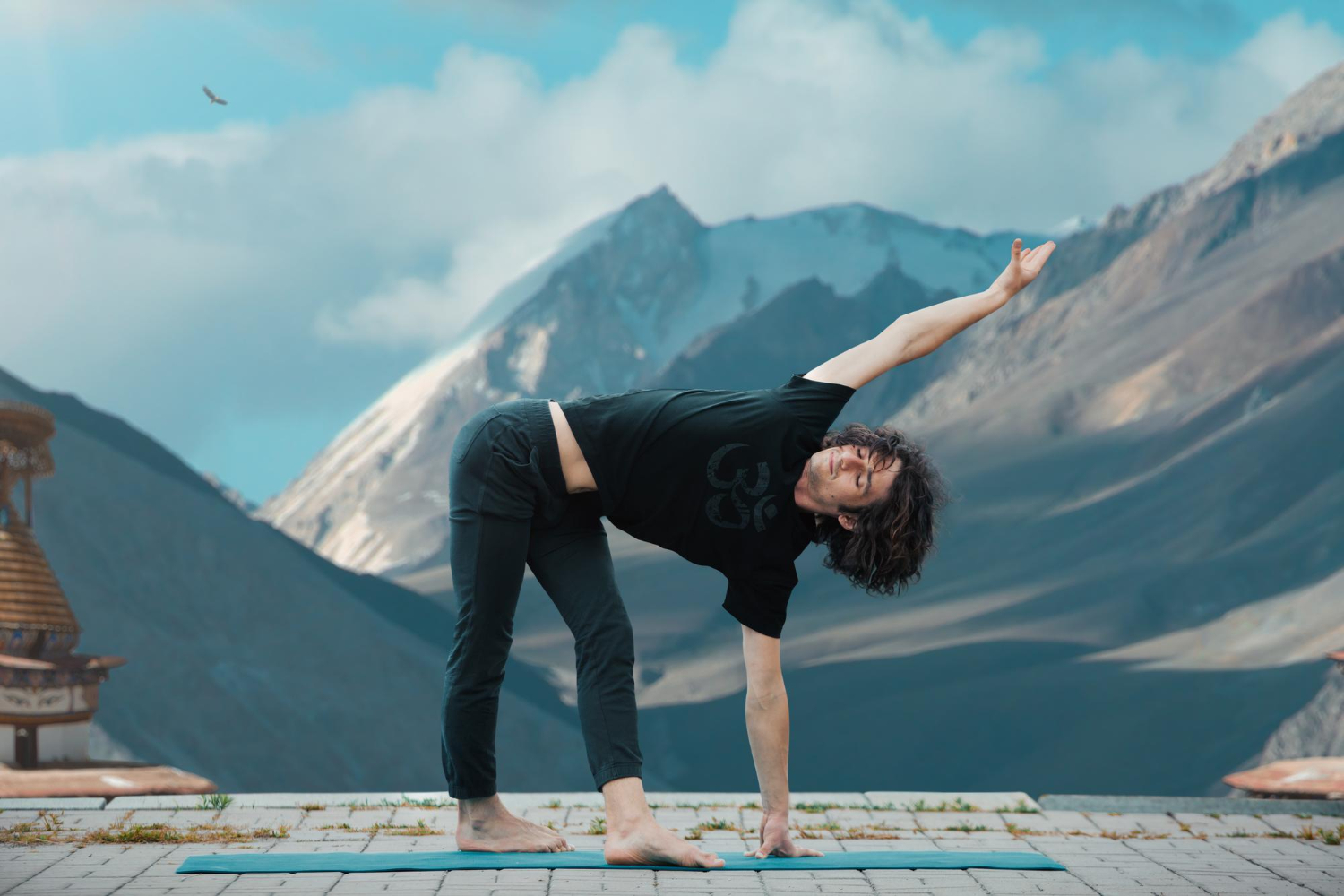
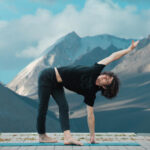
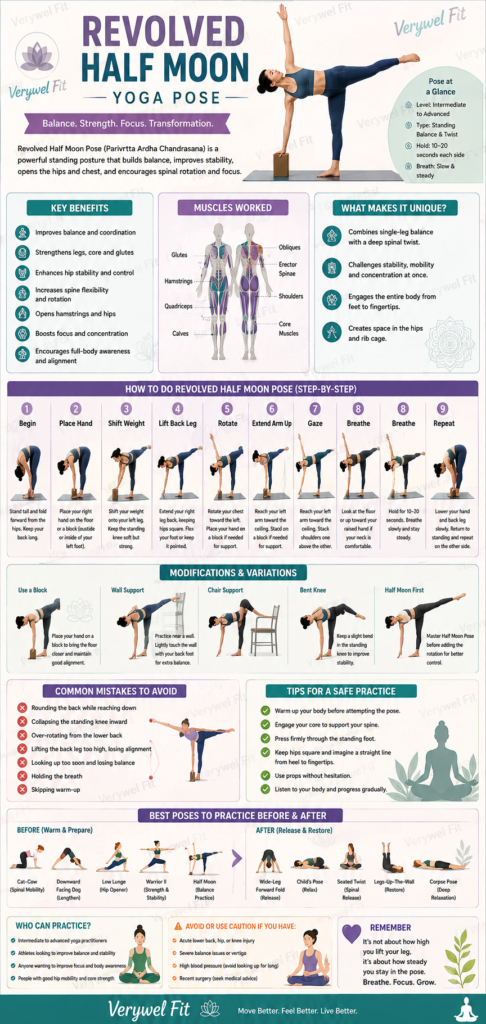
Revolved Half Moon Pose, commonly known by its Sanskrit name Parivrtta Ardha Chandrasana, is an advanced standing yoga posture that combines balance, hip stability, spinal rotation, leg strength and concentration.
The pose is a variation of Half Moon Pose. Instead of keeping the torso facing sideways, the practitioner rotates the upper body toward the standing leg while extending the opposite arm toward the ceiling.
Because the posture combines several demands at once, it can be challenging even for people who regularly practice yoga.
Revolved Half Moon is not simply a stretching pose. It requires you to coordinate:
Histórias relacionadas
 Será que a meditação e a hipnoterapia realmente podem reprogramar sua mente? Saiba mais sobre isso.
 Como fazer Chaturanga Yoga: um guia abrangente
- Single-leg balance
- Hip stability
- Hamstring mobility
- Thoracic rotation
- Core control
- Foot and ankle stability
- concentração
- respiração controlada
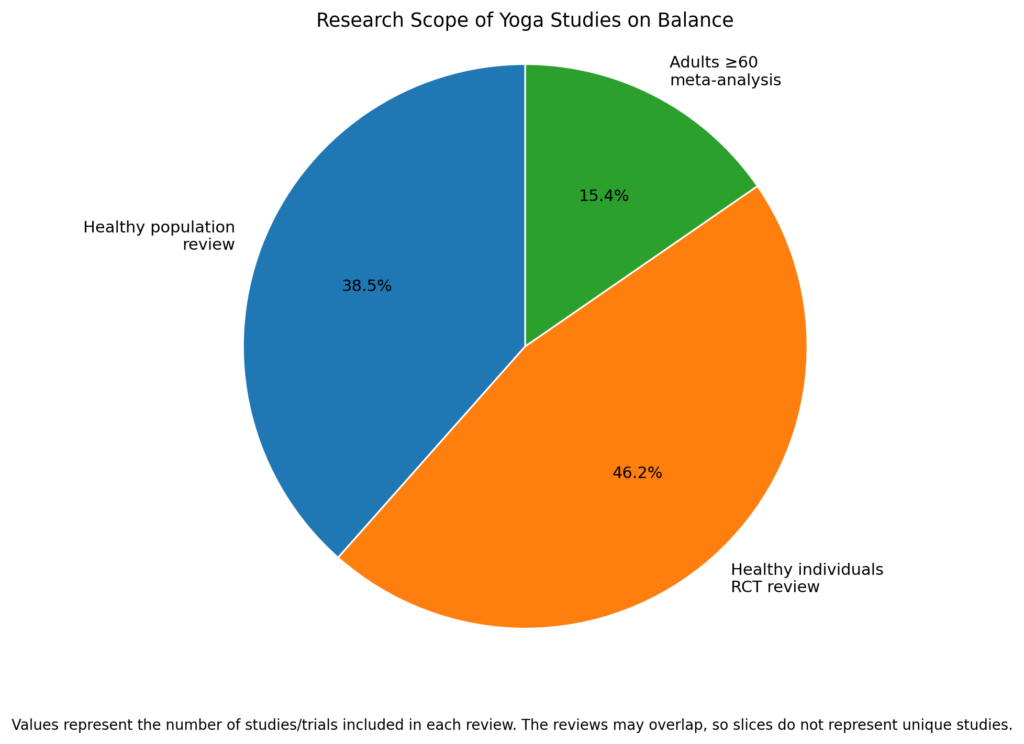
A systematic review of yoga in healthy populations found that yoga may improve balance, although the researchers emphasized that differences in study design and reporting make definitive conclusions difficult.(1) More recent evidence from 18 randomized controlled trials involving 1,408 healthy participants also found low-certainty evidence that yoga can improve balance, although the studies used many different yoga styles and balance assessments.(2)
It is important to understand that these studies examined yoga generally, not Revolved Half Moon Pose specifically.
How Is Revolved Half Moon Different From Half Moon Pose?
The two poses share a similar foundation but differ significantly in the position of the torso.
Half Moon Pose.
In Half Moon:

- One leg supports the body.
- The other leg extends backward.
- The chest generally opens toward the side.
- One hand may remain on the floor or a block.
- The opposite arm reaches upward.
Revolved Half Moon Pose.
In Revolved Half Moon:
- One leg supports the body.
- The opposite leg extends backward.
- The torso rotates toward the standing leg.
- One hand reaches toward the floor or block.
- The opposite arm reaches upward.
- The spine and rib cage rotate while the pelvis remains relatively controlled.
This rotation makes Revolved Half Moon more technically demanding.
What Does Revolved Half Moon Work?
The pose engages several muscle groups simultaneously.
Standing Leg.
The standing leg works to stabilize the body.
It may involve:
- quadríceps
- tendão
- Gluteal muscles
- Calf muscles
- Foot and ankle stabilizers
Extended Leg.
The lifted leg requires hip extension and stabilization.
The gluteal muscles and hamstrings contribute to maintaining the leg position.
Núcleo.
The abdominal and trunk muscles help control the torso during rotation.
Estes incluem:
- reto abdominal
- oblíquo
- Abdomina transversal
- Deep spinal stabilizers
parte superior do corpo.
The arms help create the characteristic shape of the posture, while the shoulder and upper-back muscles contribute to maintaining the position.
Benefícios da pose giratória de meia lua.
Because direct research on Revolved Half Moon itself is limited, the following should be understood as potential benefits based on the movement demands of the pose and broader evidence on yoga and balance training, rather than proven medical effects of this individual posture.
1. Challenges Balance.
Balance is one of the defining characteristics of Revolved Half Moon.
You are supporting most of your peso corporal on one leg while the torso rotates and the other leg extends backward.
This requires continuous adjustments from the:
- Feet
- tornozelos
- Knees
- quadris
- medula
Research examining yoga as a whole has found promising evidence for improvements in balance. A 2025 systematic review of 18 randomized controlled trials found that almost all included studies reported positive effects on balance compared with no-intervention controls, although the certainty of evidence was low.
2. Develops Lower-Body Stability.
Standing on one leg requires the hip and ankle muscles to work continuously.
This can help you become more aware of how your foot, knee and hip interact during single-leg movement.
However, good technique is more important than holding the pose for a long time.
3. Encourages Hip Control.
The lifted leg and standing leg have different roles.
The standing hip needs to stabilize the pelvis while the opposite leg extends backward.
This creates a useful challenge for hip control.
4. Challenges Core Stability.
The torso rotates while the body remains balanced over one leg.
The abdominal and spinal muscles therefore contribute to controlling unwanted movement.
The goal isn’t to create maximum abdominal tension.
Instead, think about maintaining a stable, controlled trunk while breathing normally.
5. Promotes Thoracic Rotation.
Revolved Half Moon includes rotation through the torso.
For many people, the thoracic spine—the middle portion of the spine—provides much of the desired rotation.
This is one reason it is important not to force the movement from the parte inferior das costas.
6. Encourages Hamstring Mobility.
The standing leg is often relatively straight while the torso moves toward the floor.
This can place a stretching demand on the hamstrings.
However, the pose should never be used to force maximum hamstring flexibility.
Using a block can reduce the need to reach the floor.
7. Improves Body Awareness.
Because so many partes do corpo are working simultaneously, the pose can encourage awareness of:
- Foot position
- Pelvic alignment
- Hip rotation
- Spinal position
- Shoulder position
- respiração
- contrapartida
This awareness can be more valuable than simply trying to make the pose look perfect.
8. Develops Concentration.
Single-leg balance combined with rotation requires attention.
If your mind wanders, it can become easier to lose balance.
This makes Revolved Half Moon an opportunity to practice focused attention.
9. Can Improve Movement Confidence.
Progressing gradually from supported variations to the full pose can help practitioners become more comfortable with challenging balance positions.
Confidence should come from controlled practice rather than forcing the posture.
10. Provides a Full-Body Challenge.
Although it looks like a flexibility pose, Revolved Half Moon involves multiple physical qualities:
- força
- mobilidade
- contrapartida
- coordenação
- estabilidade
- concentração
That combination makes it a demanding posture.
How to Do Revolved Half Moon Pose?
Beginners should use a yoga block or practice near a wall.
Step 1: Begin in Standing Forward Fold.
Start with your feet comfortably positioned.
Fold forward from the hips.
Keep the knees slightly bent if necessary.
Step 2: Place One Hand on a Block.
Place the hand opposite the standing leg on a yoga block.
The block can be positioned at different heights.
Choose the height that allows you to maintain control without rounding excessively.
Step 3: Shift Weight Onto One Leg.
Gradually transfer your weight onto the standing leg.
Keep the standing knee soft rather than aggressively locking it.
Step 4: Lift the Opposite Leg.
Slowly extend the opposite leg backward.
Try to keep the pelvis relatively controlled.
You don’t need to lift the leg extremely high.
Step 5: Rotate the Torso.
Begin rotating the chest toward the standing leg.
Think about rotating through the upper and middle back rather than forcing the lower spine.
Step 6: Extend the Upper Arm.
When stable, extend the opposite arm toward the ceiling.
The arms create a vertical relationship between the floor and ceiling.
Step 7: Find a Stable Gaze.
Look toward the floor initially.
If balance improves, you can gradually turn your gaze toward the upper hand.
There is no requirement to look upward.
Step 8: Breathe.
Take slow, comfortable breaths.
Avoid holding your breath.
Step 9: Exit Slowly.
Lower the raised arm.
Gradually lower the lifted leg.
Return to a forward fold before standing.
Repeat on the opposite side.
How Long Should You Hold Revolved Half Moon?
Beginners don’t need to hold the pose for a long time.
Start with approximately:
10–20 seconds per side.
As balance improves, you can gradually increase the duration.
Quality is more important than duration.
A controlled 10-second hold is more useful than a 60-second hold with poor alignment.
Revolved Half Moon With a Yoga Block.
A block is one of the best modifications for beginners.
It helps reduce the distance between the hand and floor.
Block Position.
You can use:
- High setting
- Medium setting
- Low setting
Start high.
As mobility and control improve, gradually lower the block if comfortable.
Don’t feel that reaching the floor is the ultimate goal.
The purpose of the block is to make the posture accessible while preserving alignment.
Revolved Half Moon Against a Wall.
A wall can provide additional support.
Stand with enough space to allow the lifted leg to move backward.
If balance becomes difficult, the lifted leg can lightly contact the wall.
This reduces the fear of falling and allows you to concentrate on the rotation.
Chair-Supported Revolved Half Moon.
A sturdy chair can be useful for beginners or people who need more support.
Place one hand on the chair while practicing the rotation.
This can be particularly useful during balance training.
Make sure the chair is stable and cannot easily slide.
Bent-Knee Variation.
If straightening the standing leg causes excessive tension, maintain a slight bend.
This may help:
- Reduce hamstring strain
- Improve balance
- Reduce knee locking
- Make the posture more accessible
Gradually straighten the leg only if it remains comfortable.
Revolved Half Moon for Beginners.
Don’t begin by attempting the full pose in the middle of a room.
Instead, follow a progression.
Level 1.
Practice standing balance.
Level 2.
Practice Half Moon with a block.
Level 3.
Practice torso rotation while keeping both feet on the floor.
Level 4.
Practice Revolved Half Moon using a wall.
Level 5.
Practice the pose with a block.
Level 6.
Gradually reduce support.
This progression allows you to develop the individual components before combining them.
erros comuns.
1. Trying to Reach the Floor.
Many practitioners become focused on getting their hand to the floor.
This can cause:
- Rounded spine
- perda de equilíbrio
- Excessive spinal rotation
- Poor hip control
Use a block instead.
2. Rotating From the Lower Back.
The goal isn’t to force the lumbar spine into rotation.
Think about lengthening through the spine and allowing the rib cage to rotate.
3. Opening the Pelvis Too Much.
It is normal for the pelvis to move somewhat, but excessive opening can change the mechanics of the posture.
4. Locking the Standing Knee.
Avoid aggressively pushing the knee backward.
Maintain active but controlled leg engagement.
5. Lifting the Leg Too High.
Higher isn’t necessarily better.
The lifted leg only needs to reach a position where you can maintain balance and control.
6. Holding Your Breath.
Breath-holding can increase unnecessary tension.
Keep breathing naturally.
7. Looking Up Too Soon.
Looking toward the ceiling makes the balance challenge more difficult.
Start by looking at the floor.
8. Practicing Without a Warm-Up.
A challenging balance-and-rotation posture should not be the first movement of your session.
Warm-Up Before Revolved Half Moon.
A useful warm-up might include:
Cat-Cow.
Move gently between spinal flexion and extension.
cão virado para baixo.
Use a comfortable version to warm the posterior chain.
Low Lunge.
Prepare the hips.
Half Split.
Gradually explore hamstring mobility.
Standing Knee Raises.
Practice single-leg balance.
Half Moon.
Rehearse the balance component before adding rotation.
A 15-Minute Preparation Routine.
Minutes 1–3.
Gentle spinal mobility.
Minutes 4–6.
Low lunges and hip mobility.
Minutes 7–9.
Hamstring preparation.
Minutes 10–12.
Single-leg balance.
Minutes 13–15.
Half Moon and gentle Revolved Half Moon preparation.
This approach is generally more appropriate than immediately attempting the full posture.
Breathing During Revolved Half Moon.
Breathing should remain steady.
tente:
Inhale: Lengthen the spine.
Exhale: Gently deepen the rotation without forcing it.
This doesn’t mean pushing your body farther with every exhalation.
The movement should remain comfortable.
Is Revolved Half Moon Good for Flexibility?
It can challenge flexibility in several areas, especially:
- tendão
- quadris
- coluna torácica
- ombros
However, direct scientific evidence specifically examining this pose’s effects on flexibility is lacking.
Research on yoga generally suggests that yoga can influence physical function and mobility, but results vary according to the type, duration and population studied.
Therefore, it is more accurate to say that Revolved Half Moon requires and practices mobility rather than claiming it definitively increases flexibility.
Is Revolved Half Moon Good for Balance?
The pose clearly challenges balance because it requires single-leg support.
Research on yoga generally provides some support for balance improvements. A 2014 systematic review included 15 studies involving 688 healthy participants and found that 11 reported significant positive results in at least one balance outcome, while also noting substantial variation in study quality and methods.
A newer 2025 systematic review of randomized trials also reported significant improvements in static balance in a pooled analysis, but rated the certainty of evidence as low because of heterogeneity and methodological limitations.
Therefore, Revolved Half Moon can reasonably be considered a balance-challenging yoga posture, but research does not establish that practicing this individual pose improves balance more effectively than other exercises.
Revolved Half Moon and Core Strength.
The pose requires trunk control.
However, it should not be considered a replacement for a complete core-strengthening program.
If your goal is core strength, you can complement yoga with exercises such as:
- Dead Bug
- Bird Dog
- prancha lateral
- pranchão
- Pallof Press
The appropriate exercises depend on your fitness level and goals.
Revolved Half Moon and Athletes.
Athletes may use rotational balance exercises to challenge coordination and control.
However, the pose should complement—not replace—sport-specific training.
For example, runners may benefit from strength and balance exercises that closely reflect running mechanics.
Athletes should also consider the demands of their sport before choosing yoga postures.
Can Older Adults Practice Revolved Half Moon?
Older adults can practice modified yoga, but the full Revolved Half Moon may be inappropriate for some people because it combines:
- Single-leg balance
- Forward bending
- rotação
- A relatively unstable position
Research suggests yoga-based exercise can improve balance and mobility in older adults. A systematic review and meta-analysis of six trials involving 307 participants found a small effect on balance and a medium effect on physical mobility.(3)
However, this does not mean that every older adult should perform Revolved Half Moon.
Safer options may include:
- Chair-supported balance
- Wall-supported balance
- Two-foot rotational exercises
- Standing hip exercises
Individual ability should determine the variation.
Revolved Half Moon During Pregnancy.
Pregnancy can change balance, joint mobility and comfort.
A demanding single-leg twisting posture may not be appropriate for everyone.
If you are pregnant, particularly later in pregnancy, use pregnancy-specific modifications and seek guidance from a qualified prenatal yoga professional.
Avoid any variation that creates:
- dor
- Dizziness
- Abdominal pressure
- Shortness of breath
- perda de equilíbrio
Revolved Half Moon With Back Pain.
If you have dor nas costas, don’t assume that twisting will relieve it.
Rotation may be comfortable for one person and aggravating for another.
If the pose produces:
- Sharp back pain
- Pain traveling into the leg
- dormência
- formigamento
- Weakness
stop and seek appropriate professional assessment.
Who Should Avoid the Full Pose?
Extra caution may be appropriate for people with:
- Significant balance problems
- Recent lower-limb injury
- Acute back pain
- Recent hip surgery
- Recent knee surgery
- Severe vertigo
- Uncontrolled dizziness
- Significant dor no pulso
This does not necessarily mean yoga must be avoided entirely.
Modified versions may be possible.
Wrist Considerations.
Revolved Half Moon commonly involves one hand supporting the body.
If you have wrist pain, use a higher block or another support.
Avoid forcing the wrist into a position that causes pain.
A forearm-supported variation may sometimes be more comfortable, depending on the reason for the wrist symptoms.
Knee Safety.
The standing knee should remain stable.
Avoid allowing the knee to collapse inward.
At the same time, don’t obsess over maintaining a perfectly rigid position.
A slightly bent, active knee can be appropriate.
Com que frequência você deve praticar?
For beginners, two to three sessions per week can provide sufficient practice.
You don’t need to perform Revolved Half Moon todos os dias.
A broader yoga routine should include:
- mobilidade
- força
- contrapartida
- relaxamento
- respiração
Variety can help prevent excessive repetition.
How to Progress Safely?
Progress one variable at a time.
Por exemplo:
First: Improve balance.
Then: Improve hip control.
Then: Add rotation.
Then: Reduce hand support.
Finally: Experiment with gaze.
Don’t progress all components simultaneously.
Revolved Half Moon vs Revolved Triangle.
Both poses involve rotation.
Revolved Triangle.
Both feet remain on the floor.
meia lua revolvida
One foot is lifted.
Therefore, Revolved Half Moon generally adds a larger balance challenge.
If you’re struggling with Revolved Half Moon, practicing Revolved Triangle can help you become familiar with the rotational movement before introducing single-leg balance.
Revolved Half Moon vs Half Moon.
Half Moon emphasizes:
- Single-leg balance
- Hip stability
- Lateral opening
Revolved Half Moon adds:
- Greater rotational demand
- More complex torso control
- Increased balance challenge
For many practitioners, Half Moon is a useful prerequisite.
How to Make the Pose Easier?
tente:
- Using a high block
- Practicing next to a wall
- Keeping the gaze downward
- Keeping the standing knee slightly bent
- Reducing the height of the lifted leg
- Practicing shorter holds
How to Make It More Challenging?
Only after mastering the basic posture, you can:
- Lower the block
- Move away from the wall
- Extend the lifted leg
- Maintain the pose longer
- Turn the gaze upward
- Transition slowly between poses
Advanced variations should never compromise control.
Is Revolved Half Moon a Good Morning Pose?
It can be included in a morning yoga sequence if the body is adequately warmed up.
However, immediately after waking, some people feel stiff.
Start with gentle mobility before attempting a demanding balance posture.
Can Revolved Half Moon Help Weight Loss?
Not directly.
A single yoga pose does not meaningfully determine perda de peso.
Yoga can contribute to physical activity, but body-weight management involves overall energy balance, dietary patterns, physical activity, sleep and other factors.
Revolved Half Moon should therefore be practiced for movement, balance, strength and mobility rather than as a calorie-burning shortcut.
How to Teach Revolved Half Moon?
Teachers should prioritize:
- proteção
- Clear setup
- Appropriate props
- contrapartida
- respiração
- Individual modifications
Avoid physically forcing students into rotation.
Verbal cues are often preferable to manually pushing a student’s torso or pelvis.
Useful cues include:
- “Lengthen your spine.”
- “Keep your standing knee soft.”
- “Press through your standing foot.”
- “Use the block.”
- “Rotate through the upper back.”
- “Keep breathing.”
- “Only turn your head when stable.”
Perguntas frequentes.
1. O que é a pose revoltada de meia-lua?
Revolved Half Moon, ou Parivrtta Ardha Chandrasana, é uma postura de yoga em pé que combina equilíbrio de uma perna, articulação para frente, rotação do tronco e estabilidade do quadril.
2 . A meia-lua revolvida é difícil?
Sim. Geralmente é considerada uma postura de equilíbrio desafiador porque combina o suporte de uma perna com a rotação da coluna vertebral.
3. Quais músculos o giro da meia-lua girada funciona?
Desafia as pernas, glúteos, isquiotibiais, panturrilhas, núcleo e músculos estabilizadores ao redor dos quadris, tornozelos e pés.
4. A meia-lua revolvida melhora o equilíbrio?
Desafia fortemente o equilíbrio, e pesquisas mais amplas sugerem que o yoga pode melhorar o equilíbrio. No entanto, a pesquisa não estabeleceu especificamente a eficácia dessa pose individual.
5. Os iniciantes podem fazer meia-lua revolvida?
Sim, com modificações. Os iniciantes devem usar um bloco de ioga e, de preferência, praticar perto de uma parede.
6. Devo usar um bloco de ioga?
Sim. Um bloco pode tornar a pose consideravelmente mais acessível e pode ajudá-lo a manter um alinhamento melhor.
7 Por que continuo caindo da meia-lua revolvida?
Razões comuns incluem estabilidade insuficiente de uma perna, rotação excessiva do tronco, olhar para cima muito cedo ou tentar levantar a perna de trás muito alto.
8. Minha perna de trás deve estar completamente reta?
Not necessarily. The leg can be slightly bent while you develop control. Gradually work toward greater extension if comfortable.
9. Where should I look?
Beginners should generally look toward the floor. Once stable, you can gradually turn your gaze toward the upper hand.
10. Is Revolved Half Moon good for the hamstrings?
It can place a stretching demand on the hamstrings, particularly in the standing leg, but it should not be used to force flexibility.
11. Is Revolved Half Moon good for the spine?
It involves spinal rotation, but it is not a treatment for spinal conditions. People with back problems should use appropriate modifications and professional guidance when needed.
12. Can I practice it with a wall?
Yes. A wall can provide additional balance support and is particularly useful for beginners.
13. How long should I hold the pose?
Start with approximately 10–20 seconds per side and gradually increase the duration as your control improves.
14. How often should I practice?
Two or three times per week can be a reasonable starting point, alongside a balanced yoga or exercise routine.
15. Can older adults practice Revolved Half Moon?
Some may be able to perform a modified version, but the full pose can be challenging because of its balance demands. Chair- or wall-supported alternatives may be more appropriate.
16. Can I practice Revolved Half Moon during pregnancy?
Pregnancy requires individualized modifications. A demanding twisting balance pose may not be appropriate for everyone, particularly as pregnancy progresses.
17. Can Revolved Half Moon cause injury?
Any challenging exercise can cause problems when performed with poor technique, excessive force or inappropriate progression. Use props, progress gradually and stop if you experience pain or dizziness.
18. Is Revolved Half Moon better than Half Moon Pose?
Neither is universally better. Revolved Half Moon adds a rotational component and is generally more complex, while Half Moon may be a more accessible starting point.
19. Can Revolved Half Moon reduce belly fat?
No single yoga pose can specifically reduce belly fat. Body-fat reduction depends on overall energy balance and lifestyle factors.
20. Is Revolved Half Moon a good core exercise?
It challenges trunk stability, but it should complement rather than replace dedicated core exercises if core strength is your primary goal.
Resumindo.
Revolved Half Moon Yoga Pose is a challenging standing posture that combines balance, hip stability, hamstring mobility, core control and torso rotation. It can be a rewarding addition to an intermediate or advanced yoga practice, but it doesn’t need to be performed without support to be effective.
Beginners should start with a yoga block and wall, keep the gaze toward the floor, maintain a controlled standing leg and focus on spinal length rather than forcing rotation.
Research on yoga more broadly suggests potential benefits for balance. A 2025 systematic review of 18 randomized controlled trials involving 1,408 healthy participants found low-certainty evidence that yoga improves balance, while earlier systematic-review evidence also reported positive balance outcomes across several yoga studies. However, these studies did não specifically test Revolved Half Moon, so the evidence should not be interpreted as proof that this particular pose treats balance disorders or medical conditions.
The best approach is to treat Revolved Half Moon as a skill to develop gradually. Build your balance first, use appropriate support, maintain comfortable breathing and progress only when you can control the movement. If you have an injury, significant balance problem, persistent pain or a medical condition affecting movement, seek individualized advice from a qualified healthcare or rehabilitation professional before attempting the full posture.
+3 de fontes
A Verywelfit possui diretrizes rigorosas para a seleção de suas fontes e se baseia em estudos revisados por pares, institutos de pesquisa educacional e organizações médicas. Evitamos o uso de referências terciárias. Você pode saber mais sobre como garantimos a precisão e a atualização do nosso conteúdo lendo nossa Política de Privacidade. política editorial.
- A systematic review of yoga for balance in a healthy population; https://pubmed.ncbi.nlm.nih.gov/24517304/
- Effect of yoga on balance, falls, and bone metabolism: a systematic review of randomized controlled trials in healthy individuals; https://pubmed.ncbi.nlm.nih.gov/39607489/
- Yoga-based exercise improves balance and mobility in people aged 60 and over: a systematic review and meta-analysis; https://pubmed.ncbi.nlm.nih.gov/26707903/