













































 تدرب
تدرب

 تأمل
تأمل







There was a time when I never really thought about my shoulders.
I could reach the top shelf, wash my hair, lift grocery bags, and exercise without giving it much thought. Then, little by little, things started to change. I noticed a slight tightness whenever I reached overhead. At first, I blamed it on sleeping in an awkward position or spending too many hours in front of my laptop. But over the following months, that stiffness became harder to ignore.
Simple movements suddenly felt restricted. Reaching behind my back to zip a dress became uncomfortable. Lifting weights at the gym didn’t feel as smooth as before. Even hanging clothes on a rack made my shoulders feel tight.
That’s when I realized I needed to learn how to improve shoulder mobility, not just strengthen my shoulders.
قصص ذات صلة
 ما هو وضع Vasisthasana: المعنى والفوائد وكيفية القيام به والاختلافات
 هل يمكن للتأمل والعلاج بالتنويم المغناطيسي أن يعيدا عقلك حقًا؟ إليك ما تعرفه
Looking back, I wish I had understood earlier that mobility and strength are two completely different things. You can have strong shoulders and still struggle with everyday movements if your joints aren’t moving through their full range of motion.
In this article, I Patrick Franco, Yoga Expertise will share everything I learned from my own experience, the mistakes I made, and the routines that genuinely helped me regain comfortable movement. Whether you’re an athlete, office worker, fitness enthusiast, or someone simply dealing with stiff shoulders, I hope my journey helps you avoid the same frustrations.
My Wake-Up Call.
For me, the problem didn’t begin with pain.
It began with stiffness.

I spend a considerable amount of time working on my computer, writing articles, researching, and editing content. Without realizing it, my shoulders slowly rolled forward. My posture became worse over time, and my upper back grew tighter.
One day during a workout, I attempted an overhead press. The weight wasn’t particularly heavy, but something felt off.
My right shoulder simply wouldn’t move comfortably.
It wasn’t a sharp pain.
It felt like my shoulder had forgotten how to move.
That experience made me curious.
Instead of continuing to push through the discomfort, I started researching shoulder mobility and discovered something surprising—many people focus only on building muscle while completely ignoring mobility.
That changed the way I approached fitness.
What Is Shoulder Mobility?
Before trying to fix anything, I needed to understand what shoulder mobility actually meant.
Shoulder mobility is your shoulder joint’s ability to move freely through its complete range of motion while remaining stable and under control.
This includes movements like:
- Reaching overhead
- Reaching behind your back
- Lifting objects
- Throwing
- Pulling
- Rotating your arm
- Pushing movements
Many people confuse flexibility with mobility.
I certainly did.
Flexibility simply refers to how much a muscle can stretch.
Mobility, however, involves your muscles, joints, tendons, ligaments, الجهاز العصبي, and even your posture working together to create smooth movement.
That means someone can have flexible muscles but still have poor shoulder mobility.
Understanding this difference completely changed my training.
Why Shoulder Mobility Matters More Than I Thought?
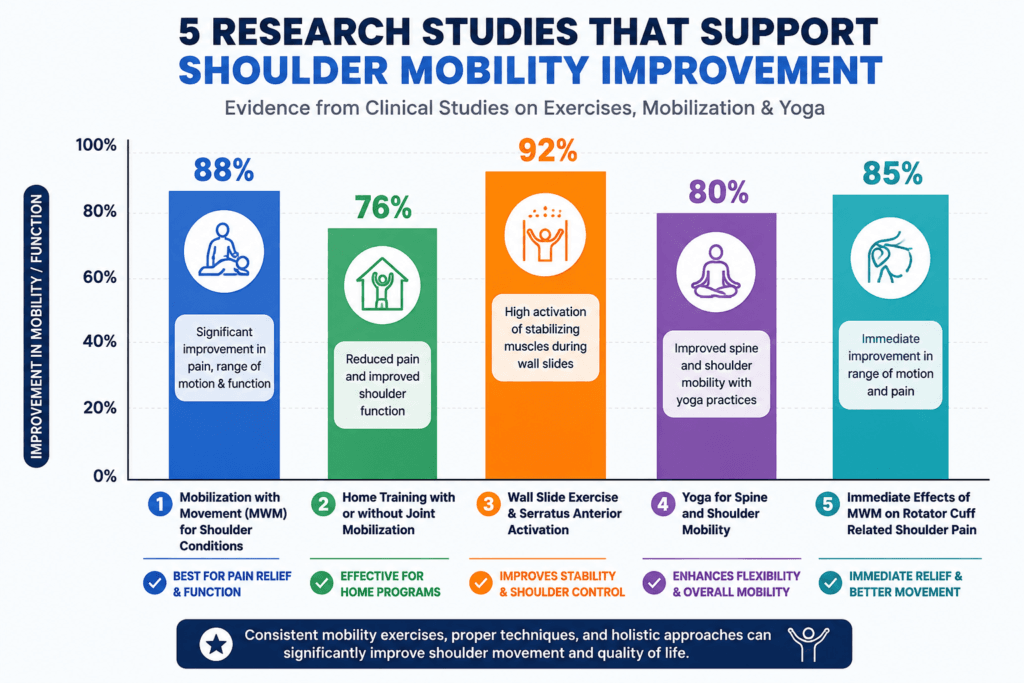
When I first started looking into improving my shoulders, I assumed mobility only mattered for athletes or yoga practitioners.(1)
I couldn’t have been more wrong.
Good shoulder mobility influences almost everything we do.
Think about your روتين يومي.
You probably reach for something on a shelf.
- Carry shopping bags.
- Drive.
- Use your phone.
- Type on a keyboard.
- Lift your child.
- Exercise.
Every one of those activities relies on healthy shoulder movement.
Without proper mobility, your body starts compensating.
- Your neck tightens.
- Your upper back rounds.
- كاف اسفل الظهر arches.
Eventually, these compensations may increase discomfort and reduce movement efficiency.
Improving mobility isn’t only about exercising better.
It’s about moving through everyday life with less restriction.
Signs Your Shoulder Mobility May Need Improvement.
Before I started my mobility routine, I noticed several warning signs.
You may relate to some of these:
- Your shoulders feel tight after working at a desk.
- Reaching overhead feels uncomfortable.
- You struggle to clasp your hands behind your back.
- Your overhead press feels unstable.
- You hear clicking sounds without pain.
- One shoulder moves differently from the other.
- Your posture has become rounded.
- You experience neck tightness after computer work.
- Your chest feels constantly tight.
- You avoid certain exercises because they don’t feel comfortable.
Having one or two of these signs doesn’t automatically mean something is seriously wrong.
However, they may indicate it’s worth paying more attention to your shoulder health.
What Caused My Shoulder Stiffness?
After observing my daily routine, I identified several habits that were likely contributing.
Sitting Too Long.
Working for hours without movement kept my shoulders in one position.
Over time, my chest became tighter while my upper back weakened.
وضعية سيئة.
I constantly leaned toward my screen.
Without realizing it, my shoulders rounded forward كل يوم.
Skipping Warm-Ups.
I used to jump straight into workouts.
I thought a few arm circles were enough.
They weren’t.
Focusing Only on Strength.
Like many people, I prioritized lifting heavier weights instead of moving better.
Eventually, my body reminded me that mobility comes first.
Lack of Recovery.
Some weeks I trained hard without giving my joints enough time to recover.
Recovery isn’t laziness.
It’s part of progress.
My Biggest Mistake.
The biggest mistake I made was assuming stretching alone would solve everything.
Every evening I spent several minutes stretching my shoulders.
Some days I felt temporary relief.
The next morning, the stiffness returned.
Later I learned that stretching is only one piece of the puzzle.
Real improvement came from combining:
- Mobility drills
- Controlled strengthening
- Better posture
- Thoracic spine exercises
- اتساق
- Daily movement breaks
That combination finally made a lasting difference.
How Long Did It Take Me to Notice Results?
People often expect instant improvements.
I certainly did.
After my first mobility session, I expected my shoulders to feel completely different.
Instead, I noticed only a small improvement.
The real changes happened gradually.
Within about two weeks of consistent practice, my shoulders started feeling less stiff in the mornings.
After a month, reaching overhead became noticeably easier.
By the second month, many exercises that previously felt awkward became much smoother.
The biggest lesson I learned was that mobility isn’t something you fix once.
It’s something you maintain.
Today, I spend just a few minutes each day on shoulder mobility exercises, and those few minutes save me from hours of discomfort later.
I Started with a Simple Shoulder Mobility Test.
A basic shoulder mobility test helped me identify whether I had enough range of motion for everyday activities. It also showed me which shoulder needed more attention.
The test was surprisingly simple.
I stood tall and reached one hand over my shoulder while bringing the other hand behind my back. Then I tried to bring my fingertips as close together as possible.
Immediately, I noticed something interesting.
My left shoulder allowed my hands to come much closer together than my right.
That told me my mobility wasn’t balanced.
I also noticed that my chest felt tight, and my upper back didn’t rotate very well. These weren’t things I had paid attention to before, but they explained why overhead movements felt restricted.
I didn’t worry about forcing my hands to touch. Instead, I used the distance between my fingertips as a reference point. Every couple of weeks, I repeated the same shoulder mobility test and noticed gradual improvement.
The Goal Was Better Movement, Not Just More Stretching.
Initially, I assumed I only needed longer stretching sessions.
I couldn’t have been more wrong.
Mobility is a combination of flexibility, joint control, muscle activation, and proper posture.
That meant my routine needed to include:
- Dynamic warm-ups.
- Controlled mobility drills.
- Strengthening exercises.
- Stretching tight muscles.
- Improving posture.
- Consistent daily practice.
Once I combined these elements, my shoulders started feeling noticeably freer.
The Shoulder Mobility Exercises That Helped Me the Most.
After trying dozens of movements over several weeks, I narrowed my routine down to a handful of shoulder mobility exercises that consistently made a difference.
These weren’t complicated, and they didn’t require expensive equipment.
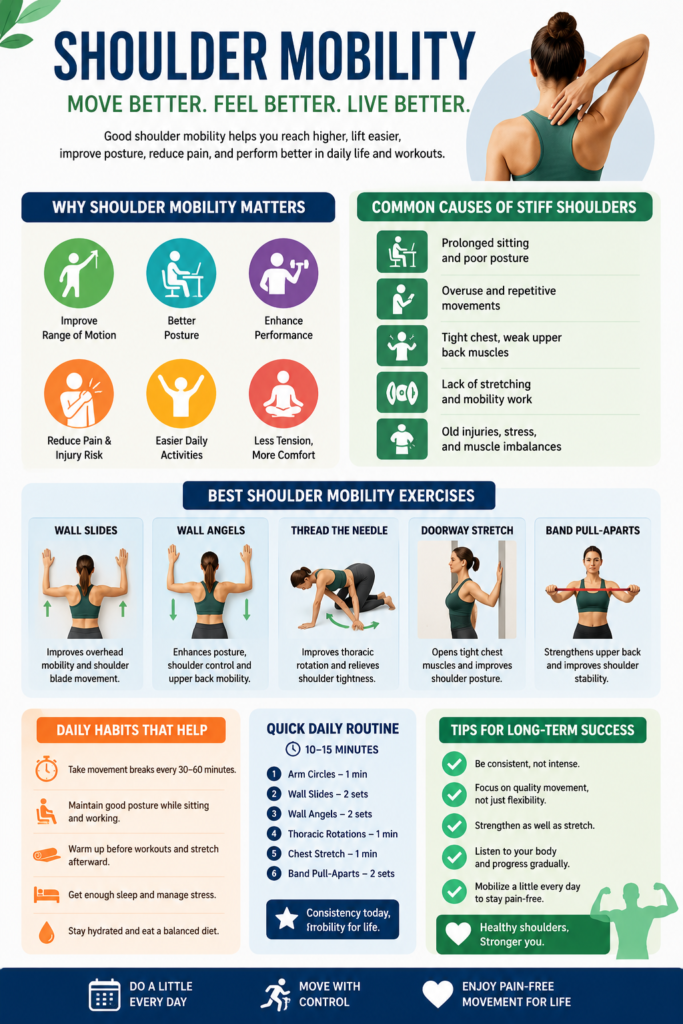
Most of them could be done at home in less than 15 minutes.(2)
1. Arm Circles.
This became my daily warm-up.
I stood with my arms extended to my sides and made slow circles.
First forward.
Then backward.
Instead of moving quickly, I focused on smooth, controlled motion.
After about a minute, I could actually feel my shoulders loosening.
What surprised me most was how different each shoulder felt. One moved effortlessly, while the other felt noticeably stiffer.
Over time, that difference became smaller.
2. Thread the Needle Stretch.
This quickly became one of my favorite mobility drills.
Starting on my hands and knees, I slid one arm underneath my body while rotating my upper back.
The stretch wasn’t only in my shoulder.
I could also feel it through my upper back and around my shoulder blade.
That was important because I later learned that poor thoracic spine mobility often affects shoulder movement.
After holding the position for a few breaths, I switched sides.
Within a few weeks, I noticed I could rotate much farther than when I first started.
3. Cat-Cow Movement.
Although many people think of Cat-Cow as a spine exercise, I found it incredibly helpful for shoulder movement as well.
As I alternated between arching and rounding my back, I focused on allowing my shoulder blades to glide naturally.
This movement helped reduce stiffness after sitting for long hours.
Whenever my shoulders felt “stuck,” a few rounds of Cat-Cow often made them feel lighter.
4. Doorway Chest Stretch.
One of the biggest contributors to my shoulder tightness turned out to be my chest muscles.
Years of desk work had shortened them considerably.
Standing in a doorway with my forearms resting against the frame, I gently leaned forward.
The stretch was intense at first.
I never forced it.
Instead, I held the position while breathing slowly.
Within a few weeks, my posture improved, and my shoulders naturally rested farther back instead of rolling forward.
5. Band Pull-Aparts.
Resistance bands became one of the best investments I made for shoulder health.
Holding the band with straight arms, I slowly pulled it apart while squeezing my shoulder blades together.
The movement looked simple.
But after a few repetitions, I realized how weak my upper back actually was.
Strengthening those muscles made a significant difference in maintaining better posture throughout the day.
Why I Added Wall Slides to My Routine?
Out of every mobility drill I tried, wall slides shoulder mobility exercises produced some of the quickest improvements.(3)
They looked deceptively easy.
Standing against a wall with my back, head, and arms touching it, I slowly slid my arms upward while trying to maintain contact with the wall.
The first time I attempted it, I couldn’t keep my wrists against the wall.
They lifted almost immediately.
That showed me just how limited my mobility really was.
Instead of becoming discouraged, I treated it as a benchmark.
After practicing regularly, I gradually noticed my wrists staying closer to the wall throughout the movement.
It was one of the clearest signs that my mobility was improving.
Wall Slides Shoulder Mobility Exercise: Small Movement, Big Results.
The wall slides shoulder mobility exercise became my go-to movement before every upper-body workout.
It helped me:
- Warm up my shoulders.
- Improve overhead movement.
- Activate my upper back.
- Increase body awareness.
- Reinforce good posture.
I particularly liked that it required no equipment.
Some mornings, I performed just two sets before work, and my shoulders felt noticeably less stiff throughout the day.
I Also Practiced Wall Angel Shoulder Mobility Drills.
Another exercise that complemented wall slides perfectly was the wall angel shoulder mobility drill.
Although it looks similar, it challenged my shoulder control in a different way.
With my back against the wall, I slowly moved my arms up and down in an angel-like motion while trying to keep my elbows, wrists, and hands touching the wall.
At first, I couldn’t complete the movement without my lower back arching.
Instead of forcing it, I reduced my range of motion and focused on quality rather than height.
Gradually, I gained better control.
This exercise improved not only my mobility but also my posture.
I found myself sitting taller at my desk without constantly reminding myself.
I Learned That Consistency Beats Intensity.
One mistake I made early on was doing long mobility sessions once or twice a week.
That wasn’t enough.
My shoulders responded much better when I practiced for just 10–15 minutes every day.
Some days I completed the full routine.
Other days I only managed five minutes.
Even then, those short sessions kept my shoulders moving.
Mobility isn’t about exhausting yourself.
It’s about giving your joints regular opportunities to move through healthy ranges of motion.
My First Signs of Progress.
The improvements weren’t dramatic overnight, but they were incredibly encouraging.
I noticed I could:
- Reach higher into kitchen cabinets.
- Wash my hair without stiffness.
- Lift weights with better control.
- Sleep without waking up with tight shoulders.
- Maintain better posture while working.
- Perform overhead exercises with greater confidence.
Perhaps the biggest change was psychological.
I stopped fearing certain movements.
Instead of worrying whether an exercise would feel uncomfortable, I trusted my shoulders again.
That confidence alone made working out much more enjoyable.
How to Increase Shoulder Mobility Without Spending Hours Exercising?
One of the biggest myths I believed was that improving mobility required long stretching sessions.
In reality, small, consistent habits made a much bigger difference.
Instead of exercising for an hour once a week, I began moving my shoulders throughout the day.
Those little moments added up.
Sometimes I simply stood up every hour and rolled my shoulders.
Other times, I performed a quick set of arm circles or wall slides before returning to work.
These tiny movement breaks helped prevent stiffness from building up.
Looking back, I think they were just as valuable as my dedicated workouts.
My Morning Shoulder Mobility Routine.
Every morning, before checking my phone or sitting down to work, I spent about 10–15 minutes preparing my shoulders for the day.
My routine looked like this:
1. Deep Breathing (1 minute).
I began with slow breaths while standing tall.
This helped relax unnecessary tension around my neck and shoulders.
It also reminded me to avoid shrugging my shoulders toward my ears.
2. Arm Circles (2 minutes).
Small circles gradually became larger.
Forward first.
Then backward.
I focused on smooth movement instead of speed.
3. Wall Slides (2 sets).
The wall slides shoulder mobility drill remained one of my favorite exercises.
Even on busy mornings, I rarely skipped it.
It immediately improved the way my shoulders felt.
4. Wall Angels.
I followed the wall slides with a few repetitions of the wall angel shoulder mobility exercise.
This helped reinforce good posture while encouraging better overhead movement.
Some mornings I struggled more than others, but I reminded myself that consistency mattered more than perfection.
5. Thoracic Rotations.
Since shoulder movement depends heavily on the upper back, I added gentle rotational exercises.
Almost instantly, I noticed my shoulders moving more freely afterward.
6. Doorway Stretch.
Finally, I stretched my chest muscles.
Because I spend many hours using a computer, this became an essential part of my daily routine.
Without it, my shoulders gradually rolled forward again.
Shoulder Mobility Stretches That Helped Me Most.
While strengthening exercises were important, I also discovered several shoulder mobility stretches that reduced tightness after long workdays.
These became part of my evening routine.
Cross-Body Shoulder Stretch.
I gently pulled one arm across my chest while keeping my shoulders relaxed.
Instead of forcing the stretch, I focused on breathing deeply.
This helped relieve tension around the back of my shoulder.
وضع الطفل.
Although often associated with yoga, Child’s Pose became one of my favorite recovery stretches.
As I reached my arms forward, I felt a gentle stretch through my shoulders, upper back, and sides.
After stressful days, this pose felt incredibly relaxing.
Puppy Pose.
This stretch targeted areas that regular shoulder stretches often missed.
I could feel a deep opening across my chest and under my arms.
The first few attempts felt challenging, but over time it became much more comfortable.
Sleeper Stretch.
I approached this one carefully.
Rather than pushing into discomfort, I used very gentle pressure.
For me, the goal wasn’t to increase flexibility as much as to restore comfortable movement.
Posture Was the Missing Piece.
For months, I blamed my workouts.
Eventually, I realized my posture was contributing just as much to my shoulder stiffness.
Whenever I sat at my desk, I unconsciously leaned toward my monitor.
My shoulders rounded forward.
My neck moved closer to the screen.
After several hours, everything felt tight.
So I made a few simple adjustments.
I raised my monitor to eye level.
I positioned my keyboard closer to me.
I kept both feet flat on the floor.
Most importantly, I stood up every 45 to 60 minutes.
Those small changes reduced my shoulder tension more than I expected.
The Importance of Upper Back Mobility.
One lesson surprised me more than anything else.
My shoulders weren’t the only problem.
My upper back was stiff too.
The thoracic spine and shoulders work together during overhead movements.(4)
If your upper back doesn’t extend or rotate properly, your shoulders often compensate.
Once I added thoracic mobility drills to my routine, overhead movements immediately felt smoother.
This was one of the biggest breakthroughs in my journey.
Mistakes I Made While Trying to Improve Shoulder Mobility.
Looking back, I made several mistakes that slowed my progress.
Hopefully, sharing them can help you avoid the same setbacks.
I Tried to Force My Range of Motion.
Whenever I couldn’t reach a position, I assumed I just needed to stretch harder.
That only increased discomfort.
Eventually, I learned that mobility should feel controlled—not forced.
Gentle progress produced much better results.
I Ignored My Upper Back.
For weeks, I focused only on my shoulders.
Once I included thoracic spine exercises, my progress accelerated.
Everything in the body is connected.
I Didn’t Warm Up Properly.
I used to begin strength training almost immediately.
Now I spend several minutes preparing my joints first.
My workouts feel much smoother because of it.
I Expected Instant Results.
This was probably my biggest mistake.
Mobility improves gradually.
Some days I noticed clear progress.
Other days, I felt as though nothing had changed.
Fortunately, I kept going.
Looking back over several months, the improvement was remarkable.
Recovery Became Just as Important as Exercise.
One thing I underestimated was recovery.
Whenever I slept poorly or trained too intensely without enough rest, my shoulders felt tighter the following day.
So I began paying more attention to:
- Getting enough sleep.
- Staying hydrated.
- Eating enough protein.
- Managing stress.
- Taking recovery days.
I realized mobility isn’t just about movement.
Your body also needs time to repair itself.
The Mental Shift That Helped Me Stay Consistent.
Instead of asking myself,
“How can I fix my shoulders?”
I started asking,
“How can I move a little better today?”
That simple shift removed the pressure.
I stopped chasing perfection.
Instead, I celebrated small improvements.
Maybe today my wall slides felt smoother.
Maybe my shoulders didn’t ache after working.
Maybe I reached a shelf without thinking about it.
Those little victories kept me motivated.
My Advice If You’re Just Starting.
If you’re beginning your own shoulder mobility journey, don’t compare yourself to anyone else.
- Your body has its own history.
- Some people improve quickly.
- Others need more time.
- Neither is wrong.
- Focus on moving with control.
- Practice regularly.
- استمع إلى جسدك.
- Stay patient.
- Mobility isn’t something you achieve once and forget. It’s something you continue to maintain throughout life.
That may sound like a lot of work, but once it becomes part of your routine, it feels as natural as brushing your teeth.
And the reward is worth it—stronger, freer, and more comfortable movement every single day.
Why Shoulder Mobility Naturally Decreases?
One question I often asked myself was:
“Why did my shoulders become stiff in the first place?”
The answer wasn’t just one thing.
Several factors work together over time.
الشيخوخة.
As we get older, our joints, muscles, and connective tissues naturally become less elastic.
That doesn’t mean stiffness is inevitable.
It simply means we need to move our bodies more intentionally.
Regular mobility work can help maintain healthy movement well into older age.
Sedentary Lifestyle.
Modern life encourages us to sit.
We sit while working.
We sit while commuting.
We sit while watching television.
When our shoulders remain in one position for hours every day, they gradually adapt to that position.
Over time, reaching overhead or behind the body becomes more difficult.
وضعية سيئة.
Rounded shoulders and a forward head posture place unnecessary stress on the muscles surrounding the shoulder joint.
I noticed that whenever I spent several hours slouching, my shoulders immediately felt tighter afterward.
Improving posture didn’t solve everything overnight, but it certainly supported my mobility work.
Repetitive Movements.
Even healthy activities can contribute to stiffness if we perform the same movement repeatedly without balancing it.
مثلا:
- Typing
- Painting
- سباحة
- Throwing sports
- Weightlifting
- Carrying bags on one shoulder
Repeating the same movement patterns without mobility exercises can eventually create muscular imbalances.
The Muscles That Changed Everything for Me.
Before learning about mobility, I assumed the shoulder was just one joint.
In reality, several muscles work together to create smooth movement.
Understanding them helped me exercise more effectively.
Rotator Cuff.
The rotator cuff consists of four small muscles that stabilize the shoulder joint.
Although they aren’t large muscles, they’re incredibly important.
Once I started including light strengthening exercises for the rotator cuff, my shoulder movements felt much more controlled.(5)
Shoulder Blade Muscles.
One of my biggest discoveries was that healthy shoulder movement depends heavily on the shoulder blades.
If the shoulder blades don’t move correctly, the shoulder joint has to compensate.
Exercises like band pull-aparts, rows, and wall slides helped improve this coordination.
Chest Muscles.
Tight chest muscles constantly pulled my shoulders forward.
Regular stretching gradually restored better alignment.
As my chest became less tight, overhead movements felt easier.
Upper Back.
My upper back turned out to be much stiffer than I realized.
Adding thoracic mobility drills dramatically improved the way my shoulders moved.
This was one of the biggest turning points in my journey.
My Long-Term Shoulder Mobility Routine.
People sometimes ask whether I still perform mobility exercises now that my shoulders feel better.
The answer is yes.
Not because I’m injured.
Because I don’t want the stiffness to return.
Fortunately, maintaining mobility requires much less work than rebuilding it.
Today, my weekly routine looks something like this:
Daily.
- Arm circles
- Wall slides
- Chest stretch
- Thoracic rotations
- Shoulder rolls
Total time: about 10 minutes.
Three Times Each Week.
- Resistance band exercises.
- Light rotator cuff strengthening.
- صفوف.
- Face pulls.
- Wall angel practice.
These movements support both strength and mobility.
Every Workout.
Before lifting weights, I always warm up my shoulders.
I no longer skip this step.
It’s one of the simplest ways I’ve found to reduce stiffness and improve movement quality.
Small Lifestyle Changes That Made a Big Difference.
Exercises were important, but so were my daily habits.
Here are a few simple changes that helped me maintain healthier shoulders.
I Stopped Sitting for Hours.
Instead of remaining seated all afternoon, I stood up every hour.
Sometimes I simply walked around the room.
Other times I performed a few shoulder rolls.
Those tiny movement breaks prevented stiffness from building up.
I Paid Attention to My Sleeping Position.
I noticed that sleeping with my arm trapped underneath my body often caused morning stiffness.
Switching to a more neutral sleeping position reduced this considerably.
I Became More Aware of My Posture.
Rather than trying to maintain “perfect posture” all day, I simply checked in with myself occasionally.
If my shoulders had crept toward my ears, I relaxed them.
If I noticed myself slouching, I gently reset my position.
These small adjustments became automatic over time.
الأسئلة المتداولة.
1. What causes lack of shoulder mobility?
Several factors can reduce shoulder mobility over time. The most common causes include prolonged sitting, poor posture, muscle tightness in the chest and shoulders, weak upper back muscles, repetitive overhead activities, previous shoulder injuries, rotator cuff problems, arthritis, and frozen shoulder. Lack of regular stretching or exercise can also make the shoulder joint stiffer. Improving posture, staying active, and performing shoulder mobility exercises consistently can help restore movement.
2. How long does it take to regain shoulder mobility?
The timeline depends on the underlying cause and how consistent you are with your exercises.
Mild stiffness: 2–4 weeks
Moderate mobility restrictions: 4–8 weeks
After injury or surgery: Several months (under the guidance of a healthcare professional)
Frozen shoulder: 1–3 years, depending on the stage and treatment
Most people notice small improvements within a few weeks if they perform mobility exercises 3–5 times per week and avoid activities that worsen stiffness.
3. What are the top 3 shoulder exercises?
If your goal is to improve shoulder mobility and overall function, these are three of the most effective exercises:
Wall Slides
Wall slides improve overhead mobility, shoulder blade movement, posture, and shoulder stability. They are suitable for both beginners and experienced exercisers.
Resistance Band Pull-Aparts
This exercise strengthens the upper back and rear shoulder muscles while helping correct rounded shoulders. It also improves shoulder blade control.
Thread the Needle Stretch
This mobility exercise targets the shoulders and upper back, increasing thoracic spine rotation and relieving stiffness from prolonged sitting.
For the best results, combine these exercises with chest stretches and rotator cuff strengthening.
4. How to loosen extremely tight shoulders?
Loosening very tight shoulders requires a combination of stretching, strengthening, and healthy daily habits.
Here are some practical tips:
Warm up with arm circles or shoulder rolls for 5–10 minutes.
Perform gentle shoulder mobility stretches, such as doorway stretches and cross-body stretches.
Include mobility drills like wall slides and wall angels.
Strengthen the upper back and rotator cuff using resistance bands.
Take movement breaks every 30–60 minutes if you work at a desk.
Improve your sitting posture by keeping your shoulders relaxed and your monitor at eye level.
Apply a warm compress or take a warm shower before stretching if your muscles feel especially tight.
Stay consistent—short daily sessions are generally more effective than occasional long workouts.
If your shoulder tightness is accompanied by severe pain, numbness, weakness, or lasts for several weeks despite self-care, consult a healthcare professional or physical therapist to identify the underlying cause.
Which exercise helped me the most?
If I had to choose just one, it would probably be wall slides shoulder mobility drills.
They improved posture, shoulder blade movement, and overhead control all at once.
That said, no single exercise works in isolation.
My progress came from combining several movements consistently.
My Biggest Lesson.
If someone had told me a year ago that spending just ten minutes a day on mobility could improve the way my entire upper body felt, I probably wouldn’t have believed them.
Now I know better.
Mobility isn’t about becoming unusually flexible.
It’s about giving your body the freedom to move the way it was designed to.
The goal isn’t to perform impressive stretches.
The goal is to reach, lift, carry, exercise, and live comfortably.
الأفكار النهائية.
Looking back, I’m grateful that my shoulder stiffness encouraged me to slow down and pay attention to how my body was moving.
It taught me that strength without mobility has limitations.
It reminded me that consistency almost always beats intensity.
Most importantly, it showed me that meaningful progress doesn’t happen overnight—it happens through small actions repeated day after day.
If you’re currently wondering how to improve shoulder mobility, my advice is simple:
Start where you are.
Be patient with yourself.
Practice consistently.
Celebrate small improvements.
And remember that every healthy movement today is an investment in how your body will feel tomorrow.
My shoulders aren’t perfect, and I still include mobility work in my routine. But today, I move with greater confidence, less stiffness, and a much better understanding of what my body needs. That, to me, has been the biggest success of all.
+5 مصادر
لدى VeryWelfit إرشادات صارمة بشأن المصادر وتعتمد على الدراسات التي راجعها الأقران ومعاهد البحوث التعليمية والمنظمات الطبية. نتجنب استخدام المراجع من الدرجة الثالثة. يمكنك معرفة المزيد حول كيفية ضمان دقة المحتوى الخاص بنا وتحديثه من خلال قراءة سياسة التحرير.
- Efficacy of mobilization with movement (MWM) for shoulder conditions: a systematic review and meta-analysis; https://pubmed.ncbi.nlm.nih.gov/34334099/
- Home training with or without joint mobilization compared to no treatment: a randomized controlled trial; https://pubmed.ncbi.nlm.nih.gov/35221520/
- A comparison of serratus anterior muscle activation during a wall slide exercise and other traditional exercises; https://pubmed.ncbi.nlm.nih.gov/17193867/
- Exploring the therapeutic effects of yoga on spine and shoulder mobility: A systematic review; https://pubmed.ncbi.nlm.nih.gov/39593648/
- The immediate effects of mobilization with movement on shoulder range of motion and pain in patients with rotator cuff-related shoulder pain: A randomized controlled trial (Evolution Trial); https://pubmed.ncbi.nlm.nih.gov/39571379/