
 Training
 Meditation





 Kontaktieren Sie uns





It was a morning when I was eating mango, my favorite fruit. At the same time, I was scrolling through the fitness reels endlessly. One hand holding the phone, the other with the spoon. The moment I realized it, the bowl was empty. I don’t remember the taste. Not the sweetness, not the juiciness — nothing.
The following day, same mango, same bowl. But this time, there was no phone. No music either. It was just me and that mango slice under the soft light coming through my kitchen window. The smell was sour and sweet. The texture? It was smooth. The taste went from my tongue to my brain. That tiny moment — silent and juicy — was a turning point in my life.
Do fruits really taste different when eaten in silence?
Yes, they do. Ayurveda, the 5,000-year-old life science, was way ahead in providing the answer even before the “mindful eating” trend appeared on Instagram.
The Ancient Secret: Mindful Bhojana.
In Ayurveda, food is not just fuel — it’s prana, the life force. How you eat decides the amount of that energy that you actually take in. There is even a Sanskrit word for conscious eating — “Mindful Bhojana”, which refers to eating with awareness, gratitude, and calmness.
According to Ayurvedic texts, your state of mind while eating has a direct impact on digestion, taste, and even the subsequent mood. Eating in silence makes the body turn on the parasympathetic nervous system – the “rest and digest” mode, as it is commonly known. This is the mode that allows the digestive fire or Agni to operate at its peak.
However, if one is eating while being distracted – i.e., watching videos, arguing, or scrolling – then the mind is also distracted. The digestive power gets weakened. Instead of nourishment, the food becomes Ama (toxins). The person may feel bloated, tired, or even emotionally dull after the meal.
In brief: “Your body can only digest what your mind can absorb.”

Science Backs It Up Too.
The same thing that Ayurveda has been saying for hundreds of years is now being confirmed by modern science. Research on mindful eating indicates that being totally engaged during the meal leads to enhanced taste perception, better digestion, and reduced overeating.
If you focus on the food:
- Your salivary glands become more active and release more enzymes, thus helping digestion.(1)
- The olfactory system (smell) gets more sensitive, thus the taste is enhanced.(2)
- The dopamine response gets stabilized, thus addictive snacking behavior is prevented.
- Have you ever wondered why we tend to finish the snacks so quickly when we’re binge-watching a series? That’s actually your brain seeking dopamine, not the sensation of hunger.(3)
Therefore, silence does not only make the fruit taste better, but it also changes your neural chemistry during the meal.
Mental Wellness Starts at the Table.
Mental wellness and food are often put into separate categories, however, they are actually deeply interconnected. Every thought you have while eating becomes part of your cellular memory.
Try to imagine the two scenarios:
You’re having a rushing breakfast and listening to a podcast about work stress, only half paying attention.
You’re sitting quietly, and you are aware of the aroma, the color, the texture of your fruit.
In the first one, your mind is focused on the future — deadlines, anxiety, and noise. In the second, it is in the present — grounded, peaceful. The second habit, over time, leads to the development of mental stillness.
According to Ayurveda, this is Sattvic eating — consuming food when in a calm state results in clarity, joy, and balance. Eating while being agitated or distracted is Rajasic or Tamasic and, therefore, may lead to restlessness or lethargy.
The point is that your eating surroundings provide nourishment not only for your body but for your mind as well.
A Practitioner’s Story — Rina’s “Silent Breakfast” Experiment.
Rina, an Ayurvedic expert from Pune, aged 42, recounted a story to me that made an impression on her and has always stayed with her.
“There was a lady with me suffering from anxiety and bloating. Her breakfast was always accompanied by email scrolling. Initially, we didn’t change her diet — only her eating habit. I instructed her to have silent meals of at least 10 minutes daily. She reported that within two weeks, not only did her digestion improve but also her anxiety diminished. Moreover, she claimed that her fruits even tasted sweeter!”
The transformation wasn’t magic — it was mindful awareness.
Rina further pointed out that senses get sharper when the mind is quiet. Taste buds are more interactive with the Gehirn. What you eat becomes a process, not a habit.
The Dosha Connection — Taste, Mood, and Silence.
According to Ayurveda, each person has a single unique Dosha- Vata, Pitta, or Kapha – which indicates the dominant tendencies of both body and mind. How one perceives food in silence may differ according to their prevailing Dosha.
Vata (Air + Space).
Vata individuals are rapid in their thinking but have a short attention span. If a Vata person eats while doing several things at once, his/her condition will worsen. Silence makes them more balanced, as it slows down their fast-moving thoughts.
Top silent fruits: Bananas, mangoes, papayas (sweet, heavy, grounding).
Tip: Warm fruit compotes or soaked figs are good for Vata relaxation.
Pitta (Fire + Water).
Pitta people are very focused, goal-oriented, and ambitious, however, they can become easily irritated. Silence during meals helps cool down their fiery temperament.
Top silent fruits: Sweet, juicy ones like melons, pears, and ripe mangoes.
Tip: Refrain from debating while eating — it only intensifies the internal heat!
Kapha (Earth + Water).
Kaphas are generally calm and loving humans, nevertheless, they can become lazy without being aware of it. Eating slowly and silently energizes them and makes them realize their inner strength.
Most silent fruits: Apples, pomegranates, berries — light and energizing.
Tipp: Do not overeat — eat slowly until you feel that the natural sweetness is enough. Hence, silence not only improves the taste but also slightly balances your Dosha thus harmonizing the mind with digestion.
Silence: The Forgotten Spice.
We are constantly talking about the health benefits and qualities of such spices as turmeric, cumin, and cinnamon, all of which are Ayurvedic spices. But what if I tell you something quite poetic –
Silence is a spice as well. Not only does it enhances food, but also alike spices it works with thoughts and even emotions.
When in silence you:
- Chew your food more slowly,
- Take a deeper breath,
- and feel gratitude.
The gratitude — not so obvious but very powerful — is becoming food for your manas (mind). You no longer treat food as a background task but rather start acknowledging it as a sacred exchange between nature and your body.
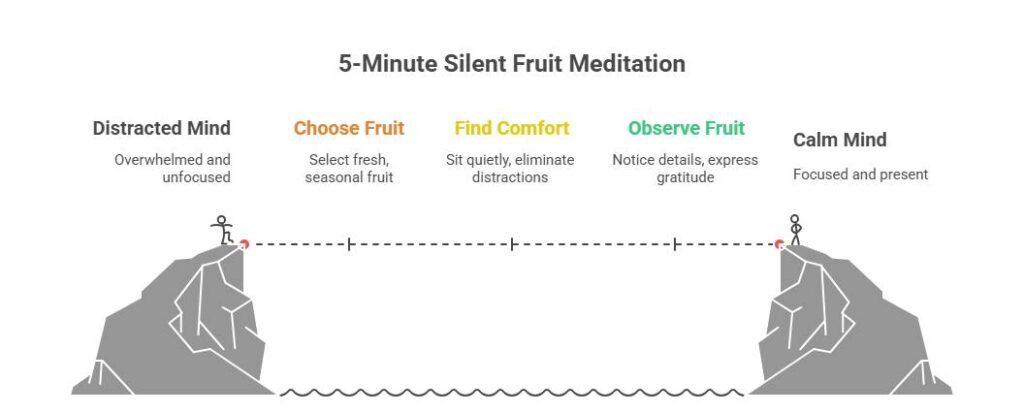
A Simple Practice: The 5-Minute Silent Fruit Meditation.
Would you like to try it out? Here’s a gentle exercise you can start today.
Step 1: Pick up a fruit. Choose something fresh and seasonal – how about a guava, orange or banana?
Step 2: Sit comfortably. No TV, no phone, no music. Use natural light if possible.
Step 3: Look at it. See the color, the texture, the weight. Thank.
Step 4: Take one slow bite. Hear the sound of chewing, the change in flavor as the fruit mixes with your saliva.
Step 5: Pause after swallowing. Taste the aftertaste. The freshness. The calm.
That’s all. Five minutes. You won’t expect how “full” that single fruit will be not only in your stomach but also in your heart.
My Own Routine Now.
I turned this into a habit. I usually sit on my balcony with one fruit – no screen, no talk – every morning around 10:30. It might be papaya one time, an apple the next, or simply a handful of soaked raisins another day.
These moments of silence have become my anchor. I chew slower. My digestion gets better. My energy during the day becomes lighter.
There are days when I drift off, my mind doing the workouts or writing the emails but then, I realize it, I come back to the taste. The fruit becomes a teacher. It helps me to be here.
Bonus: Ayurveda’s 3 Golden Rules for Eating.
Would you like to take your mealtime beyond silence? Ayurveda has these everlasting tips for you:
- Consume food when you are calm and not emotionally driven. Don’t ever eat immediately after a fight, a hard workout, or the receipt of bad news. Take a breath before you eat.
- Chew until you notice the sweetness.When that natural sweetness is chewed, it is a signal for swallowing and digesting.
- Before eating, give some thanks to the food. There is no need for a long prayer-even a simple “thank you” given to the food or the farmer is enough.
The Spiritual Side of Silence.
In yogic tradition, silence (Mauna) is not the absence of sound — it is the presence of awareness.
When you eat in silence, you become one with the act itself. You realize that food is not something different from you — it becomes you.
The transition from consumption to connection is what really feeds the soul.
Not only that, you start tasting not just the sweetness in fruit but the sweetness in life itself.
Expert Review: Dr. Meera Iyer, Ayurvedic Physician & Digestive Health Specialist.
“This article is a perfect combination of modern mindfulness and Ayurvedic wisdom. In my clinical practice, I have observed remarkable improvements in patients’ digestion, anxiety, and even sleep when they start eating in silence.
According to Ayurveda, the manner of eating is as important as the food itself. Silence helps Agni to function without interruption, invigorates prana flow, and brings stability to the mind’s doshas.
Changing your diet is not the first thing I advise my patients to do, rather, I tell them to change their state of mind at the table. That is the real beginning of healing.”
Expert Interview: Ananya Deshpande, Ayurvedic Nutrition Coach & Yoga Therapist.
Q: Do you really notice a difference in taste when eating mindfully?
A: Yes, every single time. When I instruct my clients to eat in silence, they frequently report that fruits taste sweeter and that they feel more satisfied with their meals — even when the portion is smaller. The reason is that awareness intensifies the flavor.
Q: What is one Ayurvedic secret for better digestion?
A: One should eat with joy and gratitude. According to Ayurveda, emotional energy becomes part of your ojas — your vital essence. A calm mind digests food in the same way that sunlight nourishes a plant.
Q: Any advice for beginners trying “silent eating”?
A: Just start. Perhaps only the first 5 minutes of your meal. Put your phone away, take a deep breath, and really meet your food.
When silence is your seasoning, every bite is sacred. 🌺
Häufig gestellte Fragen.
1. Why does food taste different when eaten in silence?
The reason for this is that your senses awaken. In silence, the person’s attention moves from external distractions to the sensory experience — the texture, aroma, and flavor of the food. Ayurveda refers to this heightened awareness as Sattva, which means clarity of perception.
2. Is it really possible for digestion to be improved by mindful eating?
Yes. Eating in a calm manner will lead to the activation of the parasympathetic nervous system which will result in the optimization of digestion and nutrient absorption. Ayurveda terms this as balanced Agni — the digestive fire that is responsible for the transformation of food into energy.
3. What is the duration for silent eating practice?
It can even be 5–10 minutes daily which can bring about a change. You can start with just one meal or one fruit. Gradually, the calm awareness you develop while eating will have an impact on the rest of your day.
Final Words: Rediscover the Taste of Stillness.
Definitely, fruits taste different when eaten in silence.
This is because silence tunes your senses, softens your mind, and awakens the intelligence of your body.
Without any noise, the orange tastes more intense.The mango tastes fresher.And you are more here — more human.
Therefore, when you eat your next fruit, why don’t you try this small revolt against the noisy world: remove your phone from the table. Take a deep breath. Hear the sound of your bite.
Maybe, you will find once more a taste that was there all along — underneath the noise.
“Eat quietly. Digest fully. Live mindfully.”— Ancient Ayurvedic Proverb
+3 Quellen
Verywel Fit has strict sourcing guidelines and relies on peer-reviewed studies, educational research institutes, and medical organizations. We avoid using tertiary references. You can learn more about how we ensure our content is accurate and up-to-date by reading our redaktionelle Richtlinie.
- Main effects of human saliva on flavour perception and the potential contribution to food consumption; https://www.cambridge.org/core/journals/proceedings-of-the-nutrition-society/article/main-effects-of-human-saliva-on-flavour-perception-and-the-potential-contribution-to-food-consumption/38199DA5D8940082753E0F1F7379E8F8?utm_source=chatgpt.com
- The role of an individual’s olfactory discriminability in influencing snacking and habitual energy intake; https://pubmed.ncbi.nlm.nih.gov/34390779/
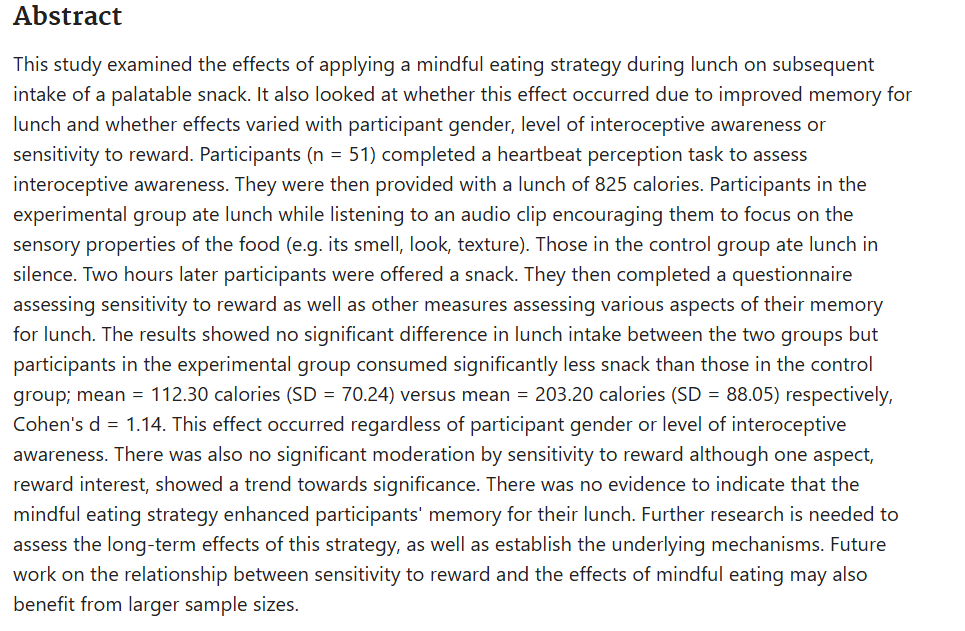
- The effect of mindful eating on subsequent intake of a high calorie snack; https://pubmed.ncbi.nlm.nih.gov/29104106/
Wie wir diesen Artikel überprüft haben:
Unser Expertenteam beobachtet ständig den Gesundheits- und Wellnessbereich und sorgt dafür, dass unsere Artikel bei neuen Informationen umgehend aktualisiert werden. Siehe unseren redaktionellen Prozess
Okt. 30, 2025
Verfasst von: Alison Acerra
Rezension von: Kayli Anderson
Verfasst von: Alison Acerra
Rezension von: Kayli Anderson











Ihr Blog ist eine wahre Fundgrube an Wissen! Ich bin immer wieder beeindruckt von der Tiefe Ihrer Erkenntnisse und der Klarheit Ihrer Texte. Machen Sie weiter so mit Ihrer phänomenalen Arbeit!
Vielen Dank für Ihren netten Kommentar.
Ich bin mir nicht sicher, woher du deine Informationen beziehst, aber es ist ein gutes Thema. Ich muss mir mehr Zeit nehmen, um mehr darüber zu lernen und es besser zu verstehen. Danke für die hervorragenden Informationen, ich habe genau danach für mein Projekt gesucht.
Danke.